I am (Deeply) Sorry
Just 14 days after we departed a camping trip in Guatemala, Feugo Volcano erupted with its most violent force in four decades. At the time of this post, its pyroclastic flows had claimed the lives of 110 people, with almost 200 more still missing. For Guatemalans living in the Volcano’s shadow, the sounds and sights of Fuego’s daily eruptions are commonplace. Though we camped more than 10 miles away, we often heard the distant rumble and viewed the black plumes spewing upward as the active volcano flared. We are deeply sorry for the people of Guatemala who treated us with such warm hospitality during our stay.
It was just one short article in the travel section of The New York Times last December. The headline, “With Mobile Camping, Remote Places and Light Footprints” was enough to catch Lynn’s eye. We were tossing around the idea of a vacation with our girls to celebrate our oldest daughter Annie’s graduation from college. The girls wanted a beach in Costa Rica. Lynn and I wanted something a little more active. Among other out of the way places to camp, the article mentioned trekking in Guatemala. Might be an interesting compromise we thought and shelved the paper in a basket of magazines in the central hall. Four months later we dug it out of the basket. In mid-May, destined for the “best family vacation ever” we were on a plane to Guatemala.

Tents at Sunrise.
Glamping is not usually our thing. What’s the challenge in camping if you don’t set up your own tent at night or tackle the task of an epicurean meal with one can of propane and two small burners? But here we were, signing up for a trip with canvas tents, cushy air mattresses, gourmet meals, someone to lug our gear from one campsite to the next, and yes, even a toilet. I secretly enjoyed the thought of carrying only a day pack. After all, I already had to be “that lady,” hiking up and down the hill to the Fairhope pier breaking in my size 10 boots, and didn’t want to add more attention by training with a giant pack on my back.
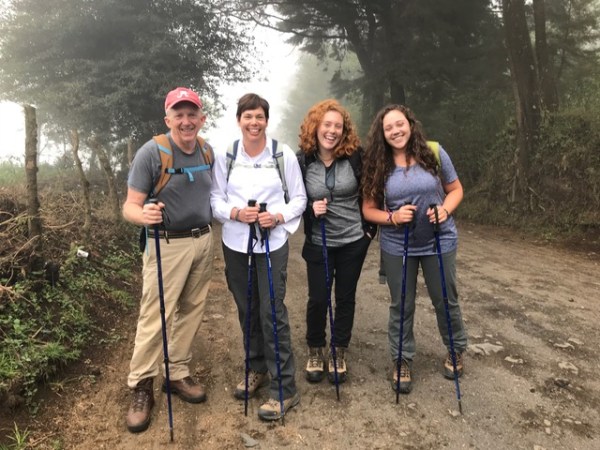
Day one at the Trailhead.
We arrived in Guatemala after navigating the first of the month at breakneck speed. Work for us, final exams for the girls, Annie’s graduation celebration with family, culling “things” collected in college, and moving the rest back home. In between, we squeezed in what exercise we could in preparation for the trip. Our lives are spent in the low lands of coastal Alabama, elevation 112 ft., and there was no way we could adequately train for Guatemala’s altitude. The trailhead would begin at 7500 ft. with the highest point of the trek topping 9000 ft. According to the planned route, in between camps, the trail would rise and dip with the mountains, leading us through tiny Mayan communities and acres of fertile farmland.
We quickly made friends with our trekking family which expanded beyond the four of us to include the owner of Trek Guatemala, a native Guatemalan guide, and two adventure tour agents gaining first-hand knowledge of the glamping experience before selling it to clients. On days two through four, local guides hired from communities along the trail, would also accompany us.

A map of the trek route hangs in the dining tent so that hikers can see the ups and downs of each day’s progress.
We began our trek easily enough, in high spirits, on a wide flat road with a mist from incoming clouds. Every twist and turn was a photo opportunity – wild roses decorating the roadside, lush forests shrouded in cloud cover, and farmers carrying bundles of leafy foliage gathered to feed hungry bovine. Day one’s uphill ascent was challenging but not impossible, offering a chance to acclimate with fewer miles to traverse. I dug in my trekking poles and accepted helpful tips on breathing for the altitude – Pranayama for the hiker, if you will, to oxygenate my blood.

A farmer gathers foliage to feed his cows. Photo courtesy Lynn Yonge
Day two was another matter. Early on in our trip, our youngest daughter Genna, who has a second college major in Spanish, schooled us in the difference between lo siento meaning “I am deeply sorry” and perdóname, an informal apology. The former she said, is often used incorrectly. But day two of our trek would find those words slipping through my brain and off my tongue like a native speaker. On the map, our route looked like a rollercoaster. First uphill, then a long downhill descent to a hanging bridge, followed by the steep uphill stretch to Fuego Camp. Still in great spirits, but not yet acclimated, I seriously questioned my ability to keep pace on the first uphill leg of the day’s journey. I lagged behind, offering apologies to my trekking family. As we snaked up the long hill single-file, I silently counted my footsteps, thinking it would at least help me mark the progress. My breath sounded ridiculously loud in my ears until at some point, my yoga practice kicked in. In yoga, I thought to myself, I move toward the pose, not afraid to admit, after ten years of practice, I still can’t touch my toes. But here on the mountain, I felt as if I needed to preface my desire for every break with lo siento. Finally, I announced, “I’m not afraid to say it, I need to stop.” Equally winded from the climb, other members of our trekking party enthusiastically embraced the rest.

Taking a break on the trail.
While it took four days of hiking to truly feel acclimated to the altitude, I soon accepted my willingness to move toward my goal of accomplishing the day’s miles, while laughing about frequent rests, rather than conquer the challenge in misery. Un momento, por favor (hold on, please), I said to our local guide at nearly every S curve. He patiently agreed, even offering to carry my daypack to make my climb easier. I gladly handed over the pack, grateful for both his help and the ability to recognize that my limitations don’t always call for “lo siento.”
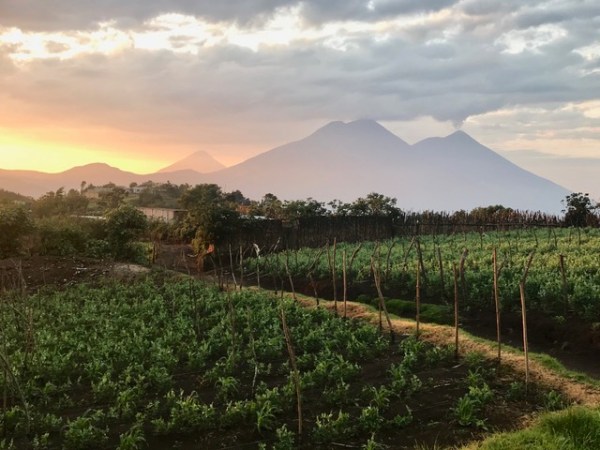
- Sunrise view of Fuego Volcano from the Trek Guatemala campsite on day two.
Inspired to go glamping in Guatemala? Contact one of these three companies to find out more information and plan your trip.
 Contented Camper