-

Pileated Woodpecker Image courtesy Audubon Guide to North American Birds
Disruptive, unruly, messy, and unwelcome. Those are the adjective best describing our last guests to visit the camp. I wish I were describing a group of ill-mannered, young adults. They would come and go. We would clean up and make a mental note not to have them back to our little corner of solitude. But these house guests, a pair of pileated woodpeckers, arrived uninvited.

A cypress porch beam damaged by woodpeckers looking for carpenter bee larvae.
It was the second year in a row the largest, known surviving species of the woodpecker family paid a visit to the camp. In fact, to every building on our property. A spectacularly, large bird with a flaming red crest, and a long sticky tongue, it’s a thrill to catch a glimpse of the pileated woodpecker and hear its repetitious call in the woods surrounding our lake. Described in our Golden 1983 edition “Birds of North America” as “uncommon; a wary bird of extensive deciduous or mixed forests,” the federally protected, Dryocopus pileatus, only visits when we’re away. It is not a thrill to find the aftermath of their destruction in the beams, trim, and cypress siding of our camp house where Lynn proudly, hand-picked every cross-beam for the front and back porches.
To be fair, we should have expected the birds. One might suggest we even rolled out the welcome mat. Lynn and his father have spent years rehabilitating the woods, once clear cut for the Alabama timber industry’s insatiable appetite, to create a habitat for native species of plants, animals, and insects. A third generation of Longleaf pines now reaches for the sky, the trees’ sturdy trunks and branches the perfect forest for the pileated woodpecker. A combination of lightning strikes and prescribed burns has left a smorgasbord of standing, dead wood, ideal for the birds’ survival.
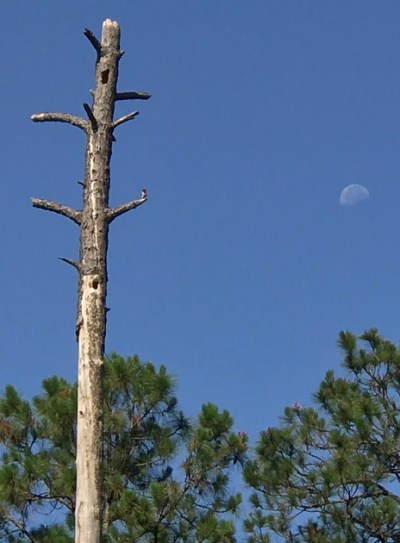
A lightening strike created a home for woodpeckers in this longleaf pine. Look closely to see the small redheaded woodpecker on lower right branch.
Our tree-farm is also well suited to the carpenter bee, a quarter-size, black and yellow striped, hover craft of an insect with a distinctively loud buzz. Carpenter bees drill dime-size, perfectly symmetrical, holes in wood, seemingly any wood – cypress, juniper, cedar, even chemically treated “yella wood” to name a few. Deep in these cylindrical tunnels, the bee deposits its eggs, which hatch as larvae and must taste to the pileated woodpecker like a fine piece of Belgium chocolate tastes to the discriminate human palette.
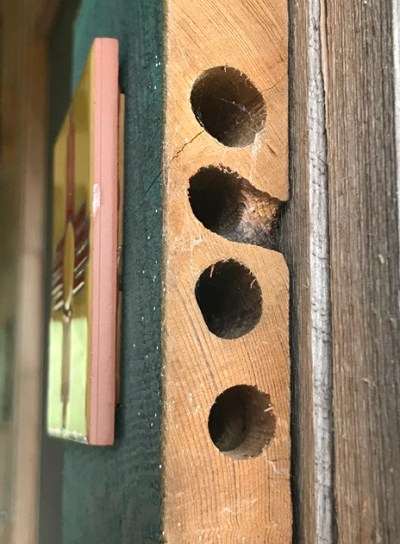
An old piece of cypress siding exhibits an example of the dime-size tunnels created by carpenter bees.
For years, we told our children not to fuss when the carpenter bees hovered around their heads and faces, perhaps mistaking the hue of recently acquired summer freckles for a former home. Leave them alone and they won’t sting was our oft-repeated mantra. And herein lies our conundrum. Long before I practiced yoga, we always believed all beings deserved to walk, crawl or fly through the world with ease. As I’ve written in this space before, we are those people who rescue spiders and other insects from inside our home, setting them free outdoors. (Case in point, recently I drove 30 mph on a busy highway until I could pull over and safely deposit the tree frog who had hitched a ride on my car’s side view mirror.)
We allowed the healthy bee population to drill their holes in our camp’s exterior wood and our hand-crafted, porch furniture. Living in harmony with these pollinators worked. Until it didn’t. Clearly the birds knew they were safe to move in when we were gone. Near every tunnel the bees created, the majestic birds tore long, splintering gashes in the wood to reach their prey. They attacked the beams, the floor boards, and in one very personal case, the pair hacked a hole in the seat of Lynn’s favorite Adirondack chair.
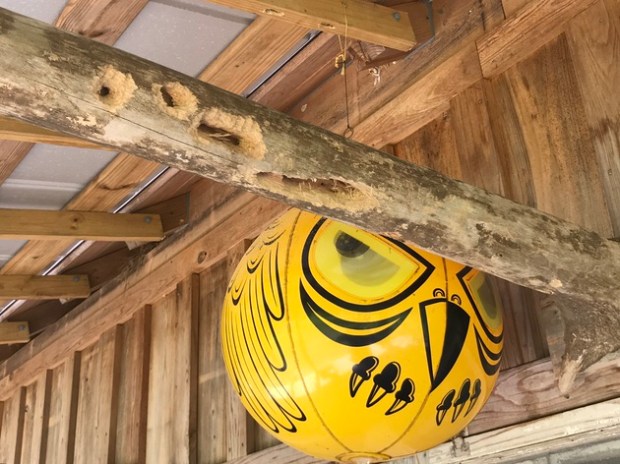
An orange ball with hologram eyes stands guard against the woodpeckers.
So what to do about the birds and bees? The oft given answer “shoot em” was not an option. In keeping with both our environmental and peaceful lifestyle, Lynn tried other methods to deter the birds. He hung giant orange beach balls like those used by NASA to scare birds away from launch pads. The balls had angry faces with hologram eyes that moved when the wind blew. Owl and hawk decoys were repositioned to stand guard and a trap designed to lower the carpenter bee population hung from the porch beams.


Sadly, nothing was a deterrent for long. Research shows eliminating the bee larvae is the most practical solution to keeping the birds away. It brings us to the age-old dilemma of man versus nature. To ease our minds, we’d like to think we’ll simply be encouraging the bees to make their homes in dead wood provided by the forest – not the lumber mill. If successful, next spring, we’ll sit on the porch in our favorite Adirondack chairs, binoculars in hand, and watch the birds and the bees from afar.
To learn more about the pileated woodpecker or to hear its call, visit The Cornell Lab of Ornithology All About Birds.
 Contented Camper