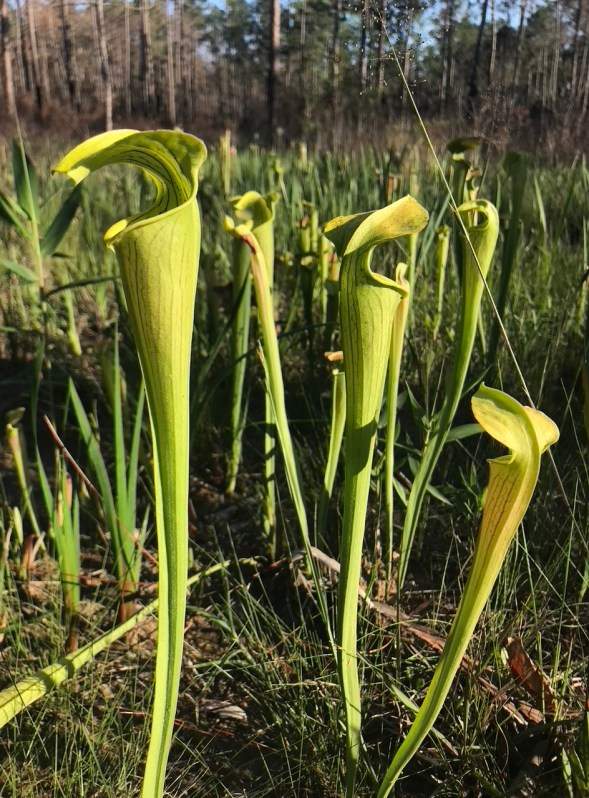
Three weeks after a fire, pitcher plants thrive in the soft ground of the pine forest.
On the first day of Work from Home (WFH), I scrubbed the bathroom floor on my hands and knees, perhaps subconsciously hoping my cleaning would ward off Coronavirus. On the second day of WFH, I set my personal best on a daily four-mile walk. I can’t tell you why. Maybe I thought I could outrun the virus. Day after day, driven by some inner force, and between work tasks (the paid kind), I tackled some new chore – weeding the flower beds, organizing the potting shed, washing windows. But after three weeks of the new normal, I was exhausted and knew it was time to trade the stress of this pandemic, not for a mop bucket or a walk around the block, but for our camp in the woods.
Feeling a bit like a criminal escaping from jail, I loaded the car and set off – looking forward to a spring drive through Mobile and Washington Counties. It’s a route that makes my head swivel as I seek small signs of nature, like the pair of osprey in their nest overlooking Mobile Bay or a spectacular display of melon-colored, native azaleas growing among a stand of hardwoods.
Our own woods offer a dozen shades of green, colors I find calming and restorative. So even though I knew it was coming, I was surprised when I arrived at our land just hours after a controlled burn. Where, that morning, the sun glinted off the verdant acres of longleaf pines, their trunks crowded with waist-high gallberry bushes, the ground was now black , tendrils of smoke still rising from charred chunks of pine lighter on the forest floor .
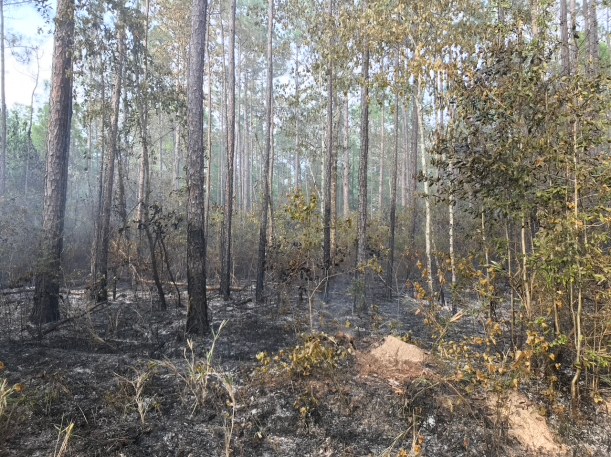
The Longleaf pine forest still smoking after a controlled burn earlier that day.
My husband Lynn tries his best not to burn in the spring, but this year, a burn ban in the dry fall and deluge of rain in the winter, left him no choice. As I pulled through the gate, driving the road which doubles as a fire line, I couldn’t help but think a controlled burn is not unlike this COVID spring. An instant stop to an out of balance ecosystem.
The purpose of a controlled burn is to both prevent wildfires and restore the biologically diverse plant and animal communities of the longleaf pine ecosystem. Other areas of the forest also benefit. We’re fortunate to have several pitcher plant bogs on our property, where each spring, the red-veined, tube-shaped, carnivorous Sarracenia rubra (sweet pitcher plant) push through the dirt, soft from the winter’s rain to emerge in breath taking clusters. Fire weeds out invasive wetland trees and shrubs, allowing the plants to flourish in the sun.

Pitcher plants in a bog uncovered after a controlled burn several years ago.
A controlled burn lets the forest pause. And perhaps this terrible pandemic gives us pause as well. We’re compelled to think about our safety and health, but also forced to slow down to a pace that allows us to weed out unhealthy thoughts or habits. Like the forest rebalancing its ecosystem, we would do well to take this mandated stay at home order to rebalance ourselves.
I won’t go so far as to say that this pandemic will change all my bad habits and I’ll emerge a new person. Some things like an affinity to work 24/7 seem hardwired. I can’t just flip a switch and turn it off. But I’m certain, taking pause will begin to create needed change. The new normal means decelerating, looking for the smallest joys, and returning to center.
My practice began In the woods that weekend. Beyond the blackened ground, I took notice of the pitcher plants, the tiniest irises, the gopher tortoises, the blue birds, and yes, even the destructive carpenter bees. All living beings, dependent upon the forests’ regrowth.
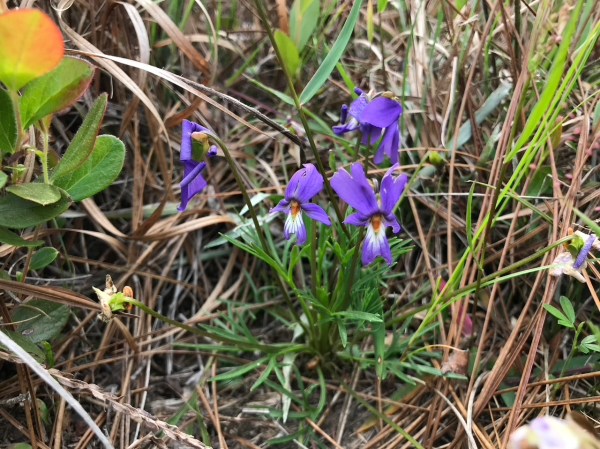
Tiny wildflowers thrive in the forest
Back home, I turned it down a notch as well. Though my “to do” list could go on and on, I set aside my expectations, no longer feeling the nagging urgency to tackle it all. The bedroom closet can wait. So can the bathroom drawer. Left with little choice but to slow down, I delighted in the magnificent show of my backyard orchids and irises, which have poured all their energy into blooming this Covid Spring.


 Contented Camper