Losing my job alongside 800 of my colleagues couldn’t do it. Neither could returning to school for a master’s degree in journalism. But there’s nothing like a couple hundred rounds of ammunition, sounding like they’re headed my way, to push me past a phobia of WordPress’s new templates and create my first blog post in more than a year.
Gunfire is what interrupted a much anticipated, lazy Saturday at the camp and has me fired up. My husband Lynn and I had just ambled down to the lake for an afternoon float; pool loungers in hand and eyes scanning the towering cumulus clouds for possible flashes of lightening. Thunderstorms aren’t uncommon on summer afternoons in lower Alabama. Gunshots are.
The first, single shot took us by surprise. It’s not remotely close to hunting season. Who would be on the other side of the lake, across the property line but a mere hundred yards away, with a rifle? We heard voices, then a rapid succession of shots, eight, 10, 12 in row, from what could only be an automatic rifle. A gun manufactured for killing people, not hunting deer. The kind of gun Alabama’s Republican politicians sling over their shoulders in campaign ads to profess their support for second amendment rights. The kind of gun used in Buffalo, Uvalde, Birmingham, and Highland Park. We retreated to the lodge’s front porch where we stayed until the first of two booming explosions, frightened the bejesus out of us, forcing us inside. I’m not ashamed to admit I let fly a few un-lady-like expletives, including wishing one of the culprits blow off an f-ing finger so that the shooting would stop.
The yahoos with guns, explosives, and (as we suspected and later verified) cheap beer, carried on for three and a half hours. Target practice or some similar recreation was their afternoon fun. We’re not sure what prompted the cease fire – a depletion of their arsenal, the approaching dusk, or a phone call by Lynn to the landowner (the land is leased to a hunting club and the owner wasn’t aware of the events). The shooting had ended but our anxiety remained high.
Lynn has walked those same longleaf pine forests for more than 50 years and has never experienced anything similar to Saturday’s escapade. He discovered later, the explosion was most likely from something called Tannerite, an explosive target made from ammonium nitrate and aluminum powder and advertised on the product’s website to “improve your rifle shooting accuracy.” We hope this episode is not a sign of a new normal, where automatic rifles and exploding targets are so ubiquitous they’ve become little more than political props and grown up toys for weekend playdates.
The firing put Lynn and I on edge, as someone in a warzone might be. The shots were unpredictable and intermittent, affecting us both psychologically and physically. I was jumpy and found myself shrugging my shoulders and squinching my eyes as I counted the rounds. As I’ve mentioned previously, Longleaf is where we retreat to escape the general noise of everyday life and the racket of our small town’s construction boom. While we can’t avoid all sounds of civilization like overhead airplanes and the drone of nearby farm equipment; for the most part, the wind brushing through the trees, the songbird’s call, and the creaking of the tin roof as it heats from the August sun, are as loud as the decibels get. So if the gun shots were making me jumpy, what were they doing to the birds, deer, possums, pine lizards, and all the other creatures whose woods we share and who are also unfamiliar with such sounds?
I had just finished reading Ed Yong’s “Our Blinding, Blaring World” in The Atlantic (2022). In the article Yong talks about Umwelt, a German word meaning environment but in this case denoting the world as organisms and animals (including humans) perceive it. Or as Yong puts it, Umwelt is all we know. It’s each animal’s sensory bubble, “perceiving but a tiny sliver of an immense world.” Yong points out as humans, through science and observation, we have the unique ability to understand the Umwelt of other species. When we rock their world with bright light, unnatural sound, and the effects of climate change, we alter other species ability to thrive.
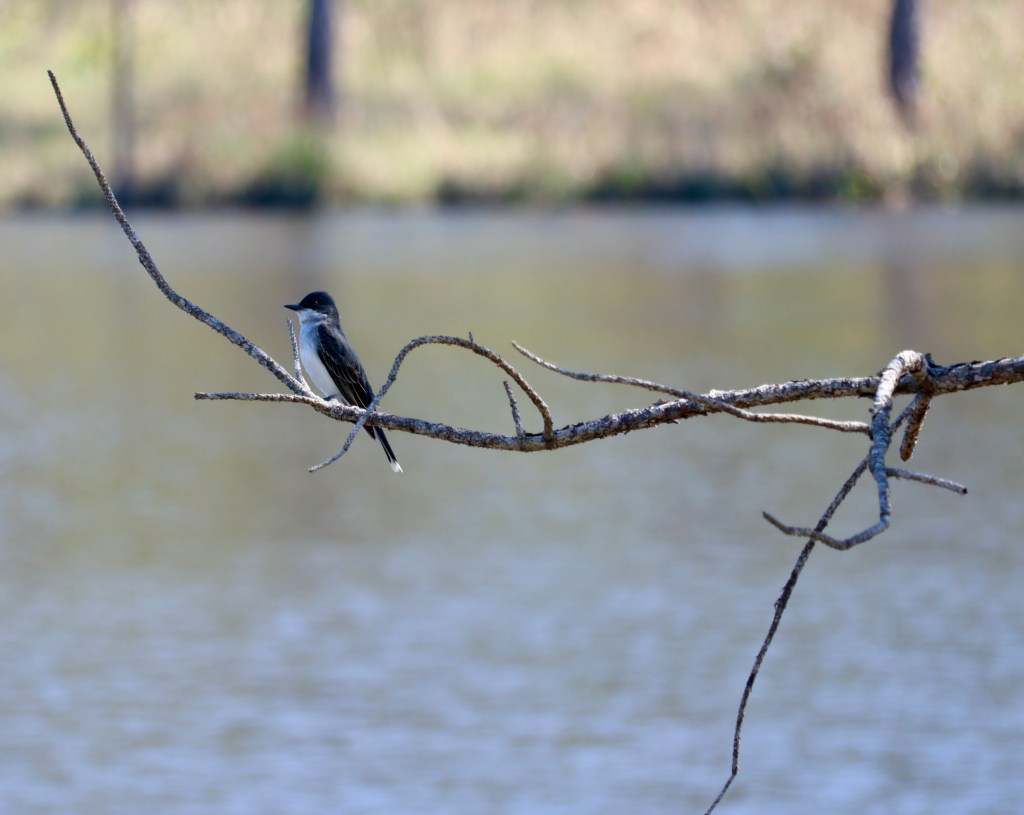
I’ve written about Asteya, the yoga concept of non-stealing. My previous post touched on how we steal from ourselves by failing to be fully present in an outdoor experience. Saturday’s example of Asteya was different. At the very least, it stole our quiet afternoon. Much more reckless was the gunfire’s harm to the earth and its wildlife, like the Eastern Kingbirds who settle near our lake each spring and summer. Members of the flycatcher family, the birds swoop over the water and tall grasses to feed on insects. The repetitive gun shots and target explosions are unnatural to the bird’s Umwelt. During the long afternoon, just as we retreated indoors, we noticed the absence of other living creatures, like the Eastern Kingbird. The Pileated Woodpecker, whose calls and sightings are common in our woods, was also noticeably missing.
As night fell and the next morning dawned, the woods slowly returned to life. But as human intrusion like our Saturday afternoon experience, steals from the earth, the list of endangered birds, mammals, and insects will continue to grow. In his article, Yong concludes even as we destroy habitats, humans are the only species who can also protect the shared world.
Connectiveness is a common theme in yoga. That is, we’re all connected, regardless of species. In the forest, it’s especially easy to perceive connection. I doubt I’ll ever meet our neighbors with the automatic rifles to explain connection, Asteya, or Umwelt. And they would probably call me crazy if I did. But as my rage from Saturday begins to fade, I can in my own naïve way, hope our neighbors will one day walk in the woods, notice the diverse ecosystem and understand their actions have consequences for all.
References
Yong, E (2022, June 13). How Animals Perceive the World. The Atlantic. https://www.theatlantic.com/magazine/archive/2022/07/light-noise-pollution-animal-sensory-impact/638446/
 Contented Camper