Home Wreckers

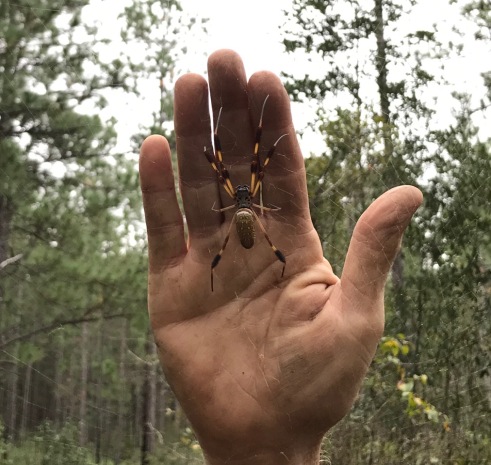
We once had a golden orb spider as a pet. She made her home high in the corner by the back door and my daughters, then in elementary school, watched her daily, secretly hoping they had their own Charlotte who would spin adjectives such as “radiant” and “humble” into her web. We all cried the day the pest control man killed our friend, sweeping her away with a long-handled broom, oblivious to the joy and wonder she brought our family.
IMG_0462


The story has stayed with us, and so some ten years later, I never imagined we would become home wreckers of not just one, but at least a dozen golden orb spiders living in the woods of Washington County, Alabama. The land is ours, a Treasure Forest my husband Lynn manages on his days off and a place where he and his father can enjoy time together. Sitting high on a tractor, my 86-year-old father-in-law grooms wide paths among the trees, opening fire lines and leading us to green fields where gopher tortoises dig their burrows and blue birds nest in boxes atop metal poles. The paths are also the perfect habitat for the golden orb spider. Clinging to longleaf pines and yaupon holly on either side of the trail, the spiders stretch their yellow-hued webs, head-high across the grassy track.

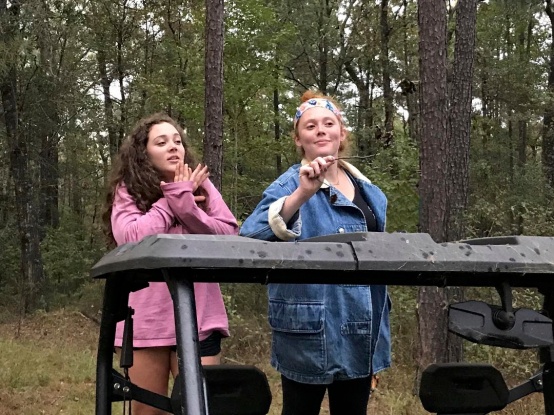
Such were the webs when we found ourselves riding through the woods on a beautiful autumn day in October. Our daughters Annie and Genna had arrived from The University of Alabama for fall break and we were all craving a little family time off the grid. “Who wants to go for a ride?” Lynn asked, backing out the UTV, brushing the dirt out of its utility bin, and indicating for us to hop in. I took the front seat with the girls choosing to hang on in back. We weren’t far down the path when the shrieking began. The spider webs, at first invisible, were perfect targets for the roof of the UTV where the poor spiders found themselves unexpectedly homeless and face to face with our daughters. Both girls are veteran campers, Outward Bound graduates, and former camp counselors, and I was surprised to see the level of fright on Genna’s face.  Surely these were not her first spider encounters.
Girls

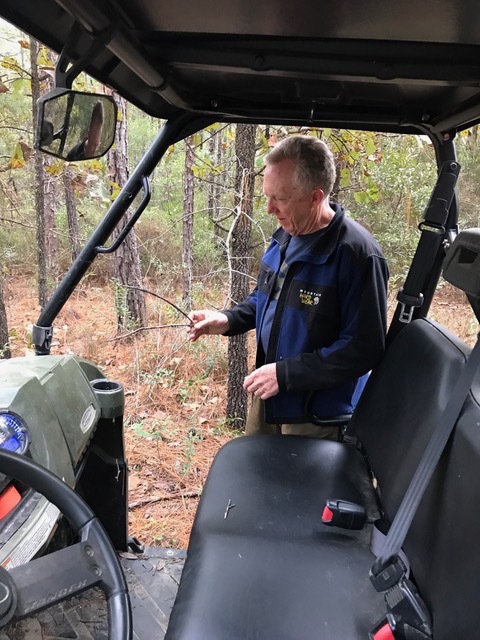
Suddenly, these tiny creatures, whose size equaled less than one percent of an adult’s body surface area, thrust us into familiar family dynamics. As if they were little girls again, Annie, fully aware Genna was terrified of getting the spider tangled in her long, curly hair, taunted Genna with a two-inch insect on the end of a stick. I tried the cliché “you’re bigger than it is, the spider won’t hurt you,” and Lynn calmly relocated each spider to the side of the path.
Lynn with spider

The situation called for a healthy dose of compassion in more ways than one. Where others, like our old pest control man, might have killed the spiders, we wished for them only a safer place to live. Annie saw the terror in Genna’s face and let up on the teasing, showing a little compassion toward her sibling.  I stopped trying to talk Genna out of her fear (in truth, I shrieked at the thought the spider landing in my hair) and she accepted her panic with grace, exclaiming at the end of the ride, “That was both terrifying and fun.”


The Beginning

Summer 2004 040

I am no stranger to camping in the South. A Girl Scout since the age of eight, I can pitch a tent in blinding rain and know enough about sleeping in the southern woods to shake out my shoes each morning. But the day my husband Lynn announced he wanted to take me on the ultimate local adventure, a canoe trip down the (sometimes navigable) upper branch of Alabama’s Escatawpa River, he was asking me to step far outside the comfort zone of my campfire circle. Little did I realize, the trip would launch a love of the outdoors as a way to connect not just with nature, but with family and friends as well.

I had listened to Lynn, an accomplished outdoorsman, talk about this canoe trip for the better part of two years. He had been dreaming of it for the last thirty. As the crow flies, we would be traveling less than twenty miles from the closest town. Despite the proximity to civilization, this was real Alabama wilderness. Not a cell phone tower in sight. Questioning the river’s hospitality, I peppered Lynn with a barrage of “what ifs” before reluctantly agreeing to paddle in the bow of the canoe. “What if something happens to you and I’m left alone on the river?” “What if we encounter a wild pig, a water moccasin, or an unfriendly gator?” My biggest fear, though, was fueled by clichés of dueling banjos and thoughts of a run-in with locals who claimed the river as their own.

Lynn spent weeks planning every detail of the trip. I greeted the UPS man daily as he delivered yet another vital piece of camping equipment. A water filter, collapsible table, backpackers stove, and the invaluable GPS lined the floor of the tiny studio behind our house.

We chose the last weekend in July for our adventure. Our two daughters and my father-in-law accompanied us to the put-in point, an abandoned wooden bridge where the sepia toned river appeared to be little more than a narrow ditch. With temperatures climbing into the 90’s we packed the canoe. The girls, ages six and eight, looked on wistfully, wishing they could stake a spot in our bright red boat. They had watched the camping equipment pile up and knew a memorable journey was in the works.

My father-in-law, on the other hand, milled around, wiping his face with a handkerchief, adding to my unease by reminding me what a brave and good wife I was. “Wish ya’all would start at the Beverly Jeffries,” he repeated over and over, referring to the bridge ten miles south where he knew the Escatawpa widened to a navigable width.

Not to be deterred, Lynn and I waved to our send off party, vowed to check in (when and if we could), then dipped our paddles in the water and launched forth into the current. Loaded with gear, our canoe felt sluggish in the shallow water and we let out a collective groan as we hit our first snag two hundred yards down stream. A large oak lay across the river, its lumbering form blocking our path. We ducked low, paddled hard and maneuvered our canoe through the tree’s highest branches. For the next five miles, the river offered up much of the same. Downed trees and thickets of cypress knees stretched from bank to bank. Small islands with high, eroding sides split the river in two, forcing us to choose, not always correctly, a direction. I became the navigator, following the current’s white foam, listening for rushing water, and opting for the most passable route.

My campfire circle was expanding. We met no one on that solitary stretch of river. Mother nature, not dangerous reptiles or human intrusion, became our biggest challenge. That’s not to say we didn’t encounter any wildlife. Once, after lunch, in a lazy post-prandial pace, we rounded a wide curve and spotted a large alligator sunning on the banks. “What do we do now,” I asked, my heart pounding with adrenaline. “It’s like passing an 18-wheeler,” Lynn answered. “Put your paddle in the water and move.” In hindsight, it’s difficult to say who was more surprised, though the gator slipped noiselessly into the water.

We camped that evening on a pristine beach. Feeling triumphant we offered each other a silly high-five and posed for a camera I had set up to take our photo. As night fell, a full moon ascended over the Escatawpa. In our tent, we listened to the low, guttural hoot of an owl and to the thrum of passing cars on asphalt, a telling sign that we were close to the next bridge.

Lynn and I awoke to a blanket of mist and the full knowledge that the next two days were certain to bring contact with people recreating on the wider and more popular length of the river. We made an early start and realized we had camped less than a mile from the Beverly Jeffries Bridge. I knew then what we would have missed if we had taken my father-in-law’s advice and “started one bridge south.”