Now is Here

Now is Here

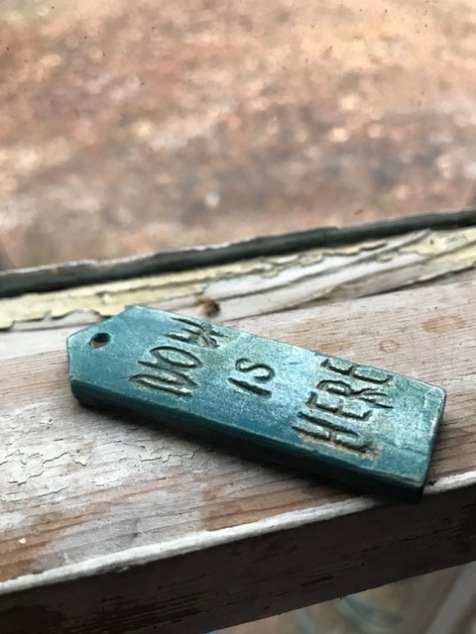
A reminder to stay present rests on the camp kitchen window sill.

“Now is Here.” That’s the advice our friend, the late artist Fred Marchman, scratched into a tiny rectangle of clay.  The creation may have been Fred’s way of doodling, not unlike the musings he wrote on his many block prints. The saying, which I sometimes transpose to “here is now,” hangs in the kitchen window of our camp house, reminding me to stay present and pay attention to nature’s gifts.

“Now is Here,” surfaced in my mind on a recent five-day canoe trip through Alabama’s Mobile-Tensaw Delta, a broad river valley terminating at the head of Mobile Bay and home to some of the most diverse wildlife in Alabama. My husband Lynn teaches a wilderness medicine elective to fourth-year medical students, training them to respond to natural disaster and humanitarian crises. The course culminates with a week-long paddle in the Delta, where students practice their skills without the modern comforts of home.
IMG_3364

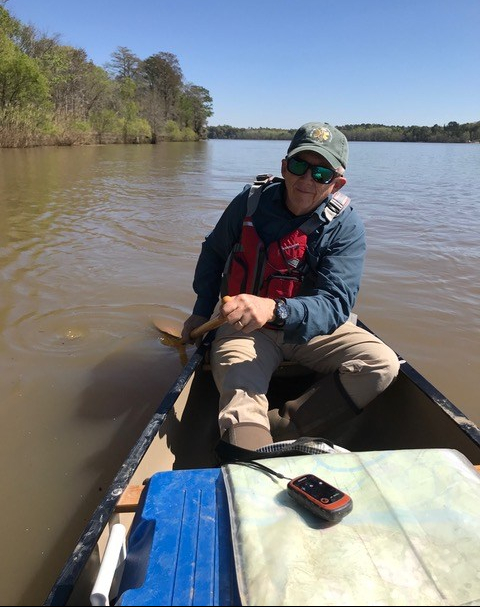
Lynn leads the expedition, following paper maps to navigate and tracking the water ways with a GPS for backup.

I went along for the ride this time, in part to lend experience, and in part, because one of the joys of a river trip, is disconnecting from the constraints of time and technology – being fully present with nature. On our very first paddle, twenty years ago, that meant putting away your analog watch and living on river time. Today, with smart phones doubling as cameras, living fully present, at a minimum, requires turning off one’s cellular data, disabling the apps and wireless accoutrements accompanying the phone – not always an easy task for those of us who check our devices more than we care to admit.
IMG_3296

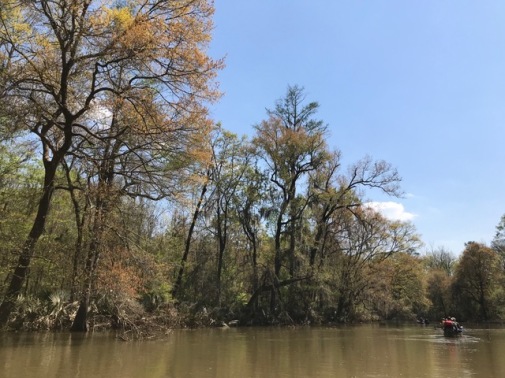
Mother nature greeted us with clear, blue skies and bald cypress trees brimming with spring color.


From day one of the expedition, it was easy to see how many members of our team couldn’t fully disconnect. Smartphones were omnipresent. I was no exception, turning on my cellular data when in range of a tower, to check for an important email I feared I would miss. Instead, I felt as if I had cheated myself. We were violating Asteya, one of yoga’s Yamas, or ethical guidelines. Asteya translates to non-stealing. In this instance, it felt as if we were robbing ourselves from being squarely present with nature, stealing our teammates’ rights to a digital free week, and failing to pay full attention to one another.  While being tuned into the device, rather than the river, who missed the cacophony of scolding ospreys as we paddled close to their nests? How about the the splash of the water moccasin as it slipped from the tree into the river? Did digital distraction steal the natural sounds of the laughing gulls, flocked together and mocking us from the shoreline?
IMG_3378

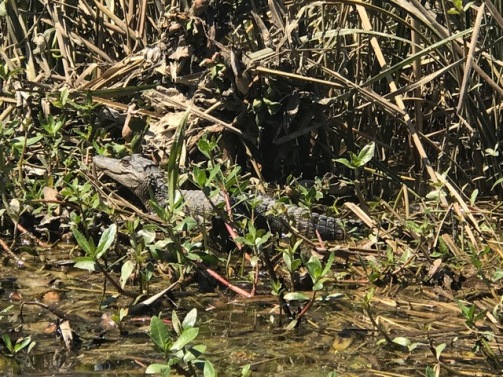
A young gator sun himself at the edge of small creek.

It will be another year before I spend a full five days in the Delta. My yoga teacher often uses the quote, “We can’t go back and start over, but we can begin again.”  This time, I’ll forgive myself for stealing from the experience. For compassion is also part of practicing yoga. I’ll begin again, learn from the discomfort, put away my own device and strongly discourage others from bringing technology as well. I’ll slip everyone a piece a paper with the saying “Now is Here” and in the true meaning of being present, we’ll watch, undistracted, as bald eagles soar against the backdrop of a bright, blue sky.



Noodle Drop

This post is dedicated to my yoga teacher, Augusta Kantra. I am grateful for your practice, your dedication, and for 10 memorable years of Saturday morning yoga. 

IMG_7473

The Chickasawhay River in Mississippi

July makes me nostalgic for river trips. For seven years running, before summer jobs, college, and the real world lured away our children, our family would choose a long July weekend to paddle a winding river on the Gulf Coast. Our entourage always included close friends — other families and teens — craving adventure and a few days spent, round the clock in bathing suits. The daily routine went something like this: coffee at sunrise, paddle 10-15 miles, hold frequent swim breaks, set up camp on a wide sandbar in the river’s curve, and conclude with a gourmet dinner and campfire.

While the point of a river trip is to get away from electronics and into nature, there is an art to bringing the proper gear so that everyone is comfortable. That responsibility always falls to my husband Lynn. In part because he loves it and in part because a childhood spent in Scouting left him gifted in planning and logistics.

When it comes to outdoor equipment Lynn is something of a gearhead. He takes great delight in not only seeking out the finest new gear, but also in fiddling with a broken camp stove, patching the hull of a canoe, or outfitting the perfect kitchen box. Although, we’ve learned from a soggy experience, it’s best to replace rather than patch a leaking tent, almost nothing gets thrown away until it’s used up.

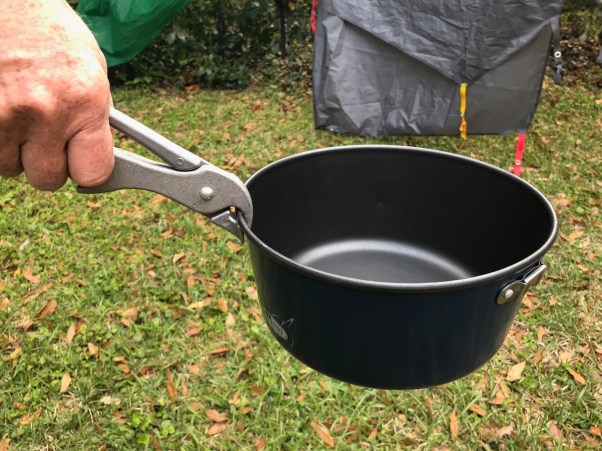
Like a favorite shirt or a child’s prized toy, it’s easy to get attached to camping gear. The old aluminum percolator smells like camp on winter afternoon. The grip on my wooden paddle evokes memories of teaching little girls to canoe. And for Lynn, a certain pair of pot grippers brought back images of childhood Scout trips – until they didn’t. (For non-camping readers, pot grippers are just what they sound like, a handle used to pick up a hot pot.)

IMG_1069

Camp cook kits come without handles for easy storage. Pot grippers are a must for handling hot pots.

One of our go-to camp meals is pasta and chickpeas. Of course, after it’s boiled, the pasta requires draining, which is where pot grippers come in handy. On our last river trip, Lynn used his faithful pot grippers to carry the noodles to the river’s edge, where the appliance failed, landing the noodles in the sand. A few curse words later, we picked up the noodles, rinsed them off, and brought them back to the cook table where I promptly dropped them in the sand. Rinse and repeat, as the weatherman says. We all ate a little grit that night and laughed that it was good for our digestion.

IMG_7405

Though not the night of the noodle drop, this is a typical kitchen set up on a river trip.

After the trip, I was sure we had retired the pot grippers. But a couple years later, during a camping trip in Tuscaloosa, the noodle drop repeated itself, only this time with potatoes on a gravel camping pad. Following a second gritty meal, it was time for those pot grippers to go.

Yoga has taught me there’s no use hanging on to something that no longer serves us well, whether it’s a thought, a relationship, a closet of unworn clothing, or in this case, pot grippers with edges slick from years of use. We can choose our freedom, walk down a different road, and not repeat our mistakes. Following the potato episode, I bought Lynn a new pair of pot grippers. Each time we use them, I’m reminded of our July river trips, but also of the lesson, sometimes you need to eat a little grit to finally let go.

IMG_1067

New pot grippers for the kitchen box.