Snake Handling

In the blackness of night and after two gin and tonics, the snake in the shower didn’t look so scary. There I stood, wrapped in an oversized beach towel, bare feet covered only by thin leather flip flops, staring at the mottled black and tan reptile resting under the twinkle lights and just above the 32 ounce bottle of Dr. Bronner’s castile soap. Stretched from wall to wall, he was easily four feet or more. At first glance, I thought it was a joke – a plastic relic from last month’s medical students who use these woods as a classroom for wilderness medicine. Lynn stood at the shower’s outer wall, his hand on the knob of the tankless water heater, ready to adjust the temperature. My encounter with the snake was brief, lasting only long enough to register its presence. I dropped the green canvas curtain, slowly backing away.

“Are you going to do something about that snake in the shower?” I calmly asked.

“What snake?” Lynn answered, moving toward the shower’s entrance.

“The one draped across the back wall.”

“I didn’t even notice him. Grab a phone, we’ll take a picture.”

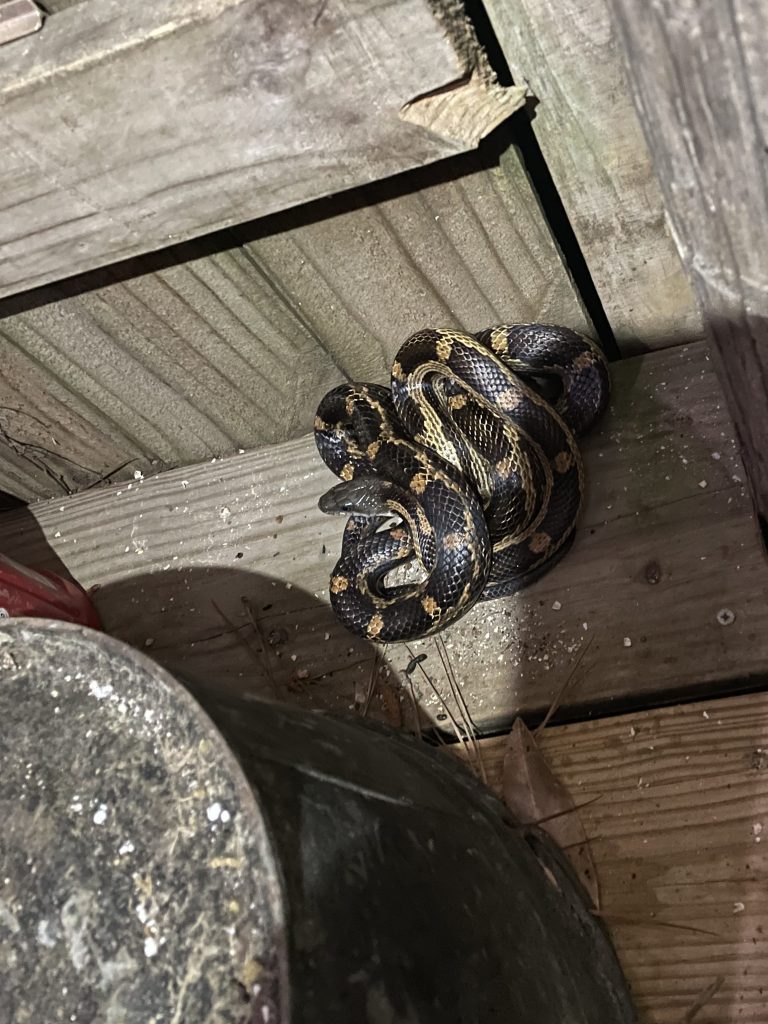
For a photo snapped with only a few twinkling LEDs for light, it’s not a bad pic. Although by the time Lynn took it, with me peering over his shoulder, the fearful snake had coiled itself into a spaghetti-like knot in the corner. After its photography session, with some nudging from Lynn and a metal bucket, the serpent slithered down a sturdy post, seeking cover in the longleaf pine needles blanketing the forest floor.

The next morning, a photo comparison to the 1979 edition of the “National Audubon Society Field Guide to North American Reptiles and Amphibians” revealed our cold-blooded friend was a Elaphe obsoleta, or as most of us know it, a common rat snake. In all likelihood, it’s the same one, although older and larger, Lynn found in the tool room adjacent to the shower. It’s worn skin, shed in a growth spurt, fills an antique mason jar and sits next to a clay face jug warding off evil spirits from the camp bookshelf. And possibly this is the very serpent who, one steamy July day, caught the humid breeze from the rafters of the dogtrot porch while my sister-in-law, a woman fearful of all slithering and crawling creatures, unknowingly trod again and again, beneath its reptilian presence.  

Like much of the wildlife on our land, the rat snake is safe here. This is a fine ethical line we walk, as invasive feral hogs with their destructive ways and prolific reproduction rates are unwelcome anywhere on the property. And carpenter bees, which attract pileated woodpeckers, long ago lost their invitation to party at the camp house. But the rat snake is a long powerful constrictor, and a skillful climber, who eats birds, eggs, mice, and other small mammals. While I prefer it stay away from the birds and their eggs, this creature is nature’s rodent control. It’s a beneficial player in keeping the ecosystem in balance.

 It’s normal to fear what we don’t know. And for many people, protecting a snake, harmless or otherwise, is counterintuitive. In Meditations from the Mat, yoga teacher Rolf Gates writes about the power of training the mind and how “confronting our fear helps to broaden our perspective.” If we see the rat snake for the role it plays in nature rather than rely on our preconceived notions to fear it, we see it through a wider lens. Letting it go to live out its life, is a better choice than harming it.

This idea, as it applies to society, wasn’t lost on me when I read the local news recently. A private organization held a drag brunch and fundraiser at our town’s civic center. It was a PRIDE month celebration by a non-profit organization who lawfully rented the space. News headlines hyped it as a notable event in conservative coastal Alabama. The news also pointed out a handful of residents opposed the event. Pictures show five protesters on a public sidewalk outside the civic center, carrying crosses and signs reading, “protect childhood innocence.”  Only adults were permitted to enter the auditorium. It seems, like those who want to harm a snake, these individuals were driven by fear of predetermined ideas. If I had to guess, the protestors had never met or had a conversation with the drag brunch organizers or entertainers. It’s a safe bet they had never bothered to ask them about their day jobs or contributions to society. If they gathered in a coffee shop or a bar, without labels and preconceived notions, would they look one another in the eye, discovering they had things in common. Maybe and maybe not. But it would be a start.

In this time, with war raging on two continents and the widening gap between left and right in our country and others, it feels more important than ever to step back and examine our fears – be they of people or reptiles. Difficult discussions and acknowledgements that things aren’t always as they appear, broaden our perspectives. The rat snake is a simple reminder that sometimes beings aren’t as scary as we believe. I’m not saying I want to share the shower with a snake (and drag queens don’t have to share the auditorium with the religious right) but knowledge and tolerance of one another help us confront our fears. The snake can stay. I’ll take the shower. It can claim the toolroom, the rafters, and all the mice it can eat. Every now and then we’ll meet and acknowledge our roles in balancing rather than harming this ecosystem.
Fired Up

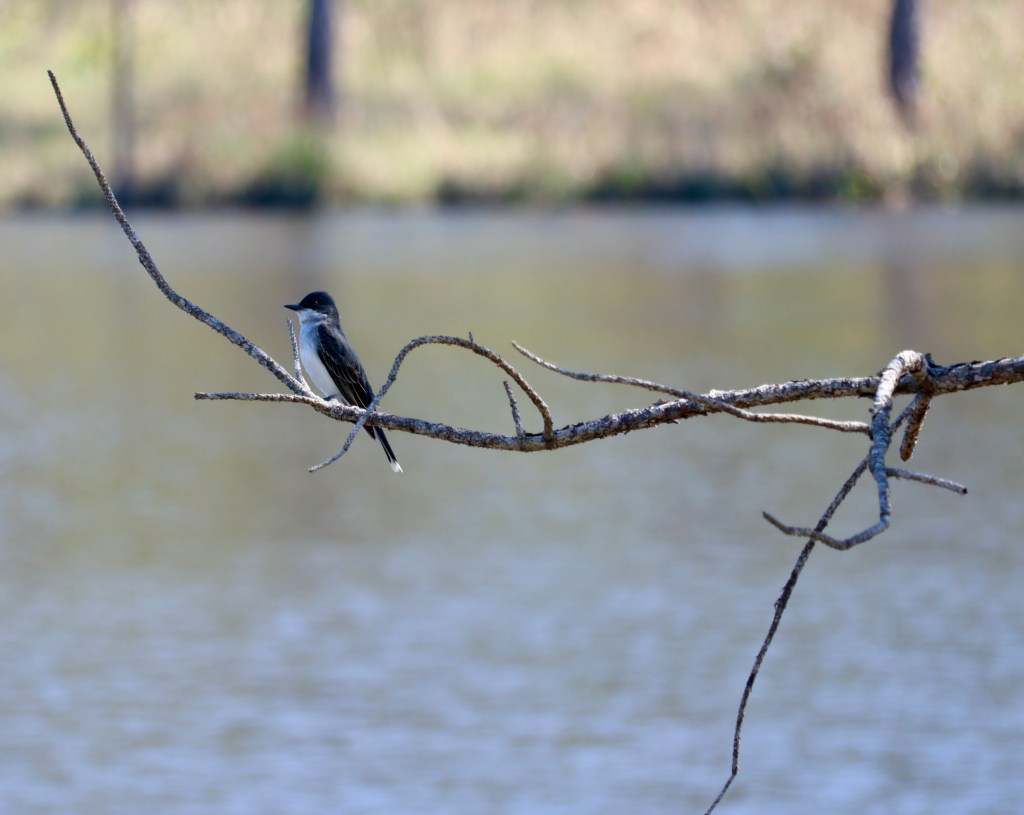
An Eastern Kingbird Perches on a Pine Branch Overlooking the Lake at Longleaf

Losing my job alongside 800 of my colleagues couldn’t do it. Neither could returning to school for a master’s degree in journalism. But there’s nothing like a couple hundred rounds of ammunition, sounding like they’re headed my way, to push me past a phobia of WordPress’s new templates and create my first blog post in more than a year.

Gunfire is what interrupted a much anticipated, lazy Saturday at the camp and has me fired up. My husband Lynn and I had just ambled down to the lake for an afternoon float; pool loungers in hand and eyes scanning the towering cumulus clouds for possible flashes of lightening. Thunderstorms aren’t uncommon on summer afternoons in lower Alabama. Gunshots are.

The first, single shot took us by surprise. It’s not remotely close to hunting season. Who would be on the other side of the lake, across the property line but a mere hundred yards away, with a rifle? We heard voices, then a rapid succession of shots, eight, 10, 12 in row, from what could only be an automatic rifle. A gun manufactured for killing people, not hunting deer. The kind of gun Alabama’s Republican politicians sling over their shoulders in campaign ads to profess their support for second amendment rights. The kind of gun used in Buffalo, Uvalde, Birmingham, and Highland Park. We retreated to the lodge’s front porch where we stayed until the first of two booming explosions, frightened the bejesus out of us, forcing us inside. I’m not ashamed to admit I let fly a few un-lady-like expletives, including wishing one of the culprits blow off an f-ing finger so that the shooting would stop.

The yahoos with guns, explosives, and (as we suspected and later verified) cheap beer, carried on for three and a half hours. Target practice or some similar recreation was their afternoon fun. We’re not sure what prompted the cease fire – a depletion of their arsenal, the approaching dusk, or a phone call by Lynn to the landowner (the land is leased to a hunting club and the owner wasn’t aware of the events). The shooting had ended but our anxiety remained high.

Lynn has walked those same longleaf pine forests for more than 50 years and has never experienced anything similar to Saturday’s escapade. He discovered later, the explosion was most likely from something called Tannerite, an explosive target made from ammonium nitrate and aluminum powder and advertised on the product’s website to “improve your rifle shooting accuracy.” We hope this episode is not a sign of a new normal, where automatic rifles and exploding targets are so ubiquitous they’ve become little more than political props and grown up toys for weekend playdates. 

The firing put Lynn and I on edge, as someone in a warzone might be. The shots were unpredictable and intermittent, affecting us both psychologically and physically. I was jumpy and found myself shrugging my shoulders and squinching my eyes as I counted the rounds. As I’ve mentioned previously, Longleaf is where we retreat to escape the general noise of everyday life and the racket of our small town’s construction boom. While we can’t avoid all sounds of civilization like overhead airplanes and the drone of nearby farm equipment; for the most part, the wind brushing through the trees, the songbird’s call, and the creaking of the tin roof as it heats from the August sun, are as loud as the decibels get. So if the gun shots were making me jumpy, what were they doing to the birds, deer, possums, pine lizards, and all the other creatures whose woods we share and who are also unfamiliar with such sounds?

I had just finished reading Ed Yong’s “Our Blinding, Blaring World” in The Atlantic (2022). In the article Yong talks about Umwelt, a German word meaning environment but in this case denoting the world as organisms and animals (including humans) perceive it. Or as Yong puts it, Umwelt is all we know. It’s each animal’s sensory bubble, “perceiving but a tiny sliver of an immense world.” Yong points out as humans, through science and observation, we have the unique ability to understand the Umwelt of other species. When we rock their world with bright light, unnatural sound, and the effects of climate change, we alter other species ability to thrive. 

I’ve written about Asteya, the yoga concept of non-stealing. My previous post touched on how we steal from ourselves by failing to be fully present in an outdoor experience. Saturday’s example of Asteya was different. At the very least, it stole our quiet afternoon. Much more reckless was the gunfire’s harm to the earth and its wildlife, like the Eastern Kingbirds who settle near our lake each spring and summer. Members of the flycatcher family, the birds swoop over the water and tall grasses to feed on insects. The repetitive gun shots and target explosions are unnatural to the bird’s Umwelt. During the long afternoon, just as we retreated indoors, we noticed the absence of other living creatures, like the Eastern Kingbird. The Pileated Woodpecker, whose calls and sightings are common in our woods, was also noticeably missing.

As night fell and the next morning dawned, the woods slowly returned to life. But as human intrusion like our Saturday afternoon experience, steals from the earth, the list of endangered birds, mammals, and insects will continue to grow. In his article, Yong concludes even as we destroy habitats, humans are the only species who can also protect the shared world. 

Connectiveness is a common theme in yoga. That is, we’re all connected, regardless of species. In the forest, it’s especially easy to perceive connection. I doubt I’ll ever meet our neighbors with the automatic rifles to explain connection, Asteya, or Umwelt. And they would probably call me crazy if I did. But as my rage from Saturday begins to fade, I can in my own naïve way, hope our neighbors will one day walk in the woods, notice the diverse ecosystem and understand their actions have consequences for all.  

References

Yong, E (2022, June 13). How Animals Perceive the World. The Atlantic. https://www.theatlantic.com/magazine/archive/2022/07/light-noise-pollution-animal-sensory-impact/638446/

Like it or Not

Like it or Not

Our front porch at Longleaf. Photo courtesy Jay Sherline

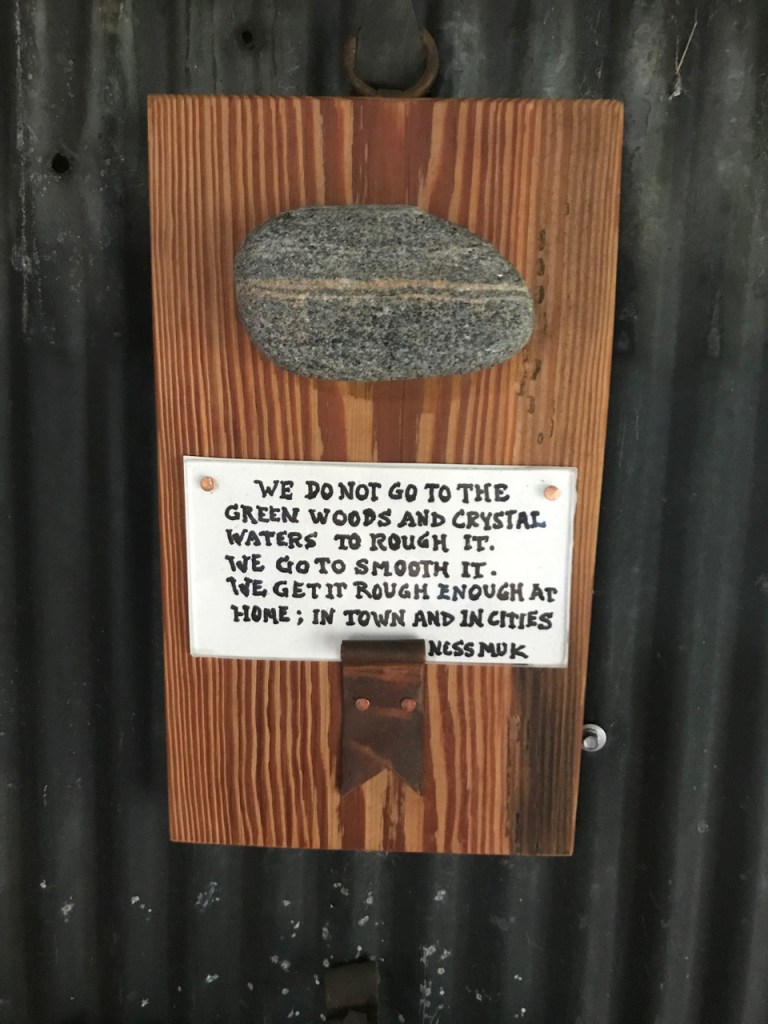
Hanging on the wall of our camp house is a stone polished smooth by years of flowing water, plucked from a now forgotten river bed during our travels. Under it, my husband has written one of his favorite quotes about nature.

“We do not go to the green

woods and crystal waters

to rough it.

We go to smooth it.

We get it rough enough at home;

in towns and in cities.”

Nessmuk


A reminder that going to the woods is not “roughing it.”

That quote rang especially true for me as I worked from home during the pandemic.  As I’ve written previously, spending time in the woods brings calm, balance, and perspective to my life. At no time was that truer than in the past 15 months when camping off the grid became a welcome escape from the real and perceived chaos surrounding me.

I’ll begin with the real chaos. Less than a month into the pandemic, we had our own scare with Covid when my husband tested positive. Mask wearing was a fledgling idea for the public, and scientists still had much to learn about the virus. Thankfully, though it was frightening for our family, Lynn had a mild case and fully recovered. As soon as he was well and we were out of quarantine, we headed to the camp. In the ensuing months, more than ever before, Longleaf became our place “to smooth it.” On weekends, we would escape to the woods but during the week, as day in and day out I worked from my home office, there was no escaping the “rough” happening in the country and our small town.

I noticed the literal noise first. Perhaps it was always there and I just wasn’t home to hear it but now the toxic noise of gas powered leaf blowers, weed eaters, and zero-turn lawn mowers interrupted my thoughts on an hourly basis. It’s as if the yardmen knew when I had scheduled my virtual meetings, and on cue cranked up their machines. I tried reasoning with myself, tempering my ugly thoughts with grateful ones – happiness for the landscapers who had safe jobs during the pandemic. 

As the months dragged on, a different kind of noise attacked my senses. News headlines screamed of the global pandemic itself, Black Lives Matter, the U.S. presidential election, the January 6, 2021 insurrection, and much more. As I cooked dinner, worked on home improvement projects, or took a quick trip to the store, I found myself constantly reading headlines or tuning into NPR. Reading, listening, discussing, and processing were necessary, difficult and often disturbing. A weekend in the woods, without access to internet, was the best reboot.

Closer to home, the yardman’s leaf blower was soon dwarfed by the sounds of the pandemic housing bubble. While we embarked on our own noisy kitchen renovation, planned months prior to the pandemic, our house was also suddenly surrounded on four sides by major construction projects. My work is not the kind that can be done from the local coffee shop. Some days I fled to my husband’s office but on others there was no escaping the unpleasant thrum of the air compressor, the whining of the electric saw, or the grinding sound of machine against brick.

A day in the life of “working from home.” My office is in the green house. It was difficult to avoid the noise.

From sun up to sun down, I was powerless to control the racket around us. One morning in a fit of exasperation brought on by the incessant warning beep of an off balance lift, I stormed out the back door, waggling my finger at the painter in the lift, and shouting for him to “please turn that damn thing off.”

Later that week, at a Saturday morning yoga class, my teacher used the phrase, “like it or not.” There was the aha moment. The noise, the chaos, the world events were all going to happen. Like it or not, I was going to be powerless to control it.  I could be the angry and resentful victim or I could question the story I was telling myself and adjust my attitude. This wasn’t a new concept, just one I had forgotten to embrace as the din grew louder both in my head and outside my window.

I expect the construction projects will extend into the fall of 2021 and like it or not, so will my hypersensitivity to the noise. Thankfully, I’m now working a hybrid schedule that gets me out of the house four days out of five. The woods will always remain the place we go to smooth it. In fact, as I write from my favorite Adirondack chair, I’m enjoying the melodies of  the natural world – the call of the Eastern King bird, the buzz of the cicadas, and the whoosh of the breeze through the trees. And one more unnatural but very familiar sound- the hum of a generator running at a nearby farm. Like it or not.

Aggravation can be inspiration for creativity. Here is a poem I wrote about the noise surrounding our home.

Pandemic Yoga
April 25, 2020

On my Yoga journey
Practicing on the front porch
The teacher in a tiny Zoom square
Then full screen.

I learn to lean into the byproduct
of the Covid Spring.
Noise Pollution.

The gas leaf blowers
Their roaring motors creating
Tornados of dust and leaves
Across the street, two houses down,
Or at the end of the alley that takes a
Dogleg turn just beyond our home.

I turn up the volume but the teacher's voice
Is replaced by the pounding of
Aggravation in my ears.
Try to soften around it I tell myself.
We are in the same storm, but
The yardmen are in a different boat.

Softening takes patience and practice.
Early Saturday, while the birds
Call and the squirrels
Tut tut to one another,
A man rides his grandchildren
Up and down the street on a zero turn mower
Eight times.
Again drowning out my teacher's voice.

Lean in, lean in, lean in,
I tell myself in twisted triangle pose.
Sit with the noise
Though it's not my preference.

find quiet in my head
Love in my heart
Learn from this storm
and its fleet of boats.

Hold What Ya Got

DSC02446

Three downed trees – one partially submerged and two across the bank, block our way.

“Hold what ya got.” How could I possibly do anything else, I thought, as I balanced in wet Chacos®, on a slippery log, trying with all my muscle to shove the bow of our loaded canoe over yet another fallen tree.

I’m sure it was nostalgia, work from home boredom, or in reflection, poor recall, that made me agree to recreate our maiden voyage down the upper portion of Alabama’s Escatawpa River. It had been 16 years since the epic journey. This time, a tropical storm delayed our departure by two weeks, initially leaving the water too dangerous for paddling but now, looking just right for a weekend of adventure and solitude.

As the saying goes, looks can be deceiving.

Travel by canoe can be much like car camping, following the reasoning, “if there’s room for the gear, you can take it with you.” We’re seasoned enough campers to know we could run into multiple obstacles and mindfully made the decision to pack light.

Our daughter Genna, now 22, dropped us at the put-in point, delighted to drive her dad’s new pick-up but bemoaning the fact she had work to do and couldn’t accompany us. In hindsight, she was one lucky girl. After snapping the send-off photo, we launched the canoe in the tannin stained water and readied ourselves for miles of unspoiled wilderness.

Send-off photo

Send-off photo

As with our initial trip years earlier, the obstacles came early. We paddled just 100 feet before encountering a freshly, downed tree across the river. Still in high spirits, we hauled the boat across, thankful we’d left the large ice chest at home, and shrugged it off as the price of seeking scenery worthy of a postcard. Back in the boat, the river seemed oddly low, as if the water was falling quickly or the gage reading we’d relied on for navigation was incorrect.

Another hundred feet – another tree. This was the scene repeated over and over for the next 10 hours, in which time we traveled a mere four miles. Nature had thrown us a doozy. If a fallen water oak or pine didn’t block our way, the water was so low it exposed an obstacle course of bald cypress knees stretching from one river bank to the other. Unlike our trip years ago, we couldn’t simply navigate between them but rather had to pick our way through on foot. Turning around meant not only dragging the boat back over the same obstructions but also paddling against the current. The next take-out point was seven miles downriver. Forward was the only way out.

Cypress knees
Low water exposed bald cypress knees stretching from bank to bank on the Escatawpa.


DSC02455

A fallen water oak and a dam of branches impeded our progress. This scene repeated itself every 100 feet or so for the first four miles of river.

In my head, I switched to yoga’s warrior pose, and the oft repeated expression, “sometimes life is just hard.” At times, when it seemed we couldn’t face another obstacle, I laughed at the absurdity of the situation, (which was a relief to Lynn who noted other middle-age women might not think it funny). Exhausted, I abandoned any clinging notion this trip would be like the first one. The concept of vairagya or non-attachment allowed me to concentrate on the present, accept the situation, and lower my expectations that the river’s next bend might offer something better. Standing on that log, “hold what ya got” became both literal and philosophical.

Just before dark, we found a beautiful campsite where we were lulled to sleep by the gurgling sounds of tiny rapids. A reward for a hard day’s work. Day one’s adventure offered nothing close to a lazy paddle, but it did remind me when life gets hard, take it one fallen tree at a time.

DSC02522

Our first night campsite on a grassy bank.


Turkey Trot

IMG_5023

Despite the name of this blog post, I’m not writing in November. There are  no Thanksgiving circulars in the paper, no Macy’s Day parade, no runners finishing a 10K before sitting down to dinner.

It’s June and I’m sitting on the porch, in our little corner of Washington County, Alabama remembering the real turkey trot – two hens and nine chicks, who circled the house less than a month ago. More importantly, I’m understanding why it happened – because we let nature do what nature does, instead of bending it to our idea of beauty and perfection.

For years, my father-in-law Preston kept a well-manicured lawn between the house and the lake. Though hardly a country estate, mowing gave the dog-trot cabin a neat appearance and kept the grass from tickling our legs while walking to take a swim. The grass was always tidiest before company arrived. This year, Preston and Lynn decided to forgo bush hogging, instead, allowing the wild flowers to bloom among the grasses.

Oh, how the turkeys and song birds love it.

Turkey Trot

The hens ignored us, while finding their breakfast in the open field of tall grass.

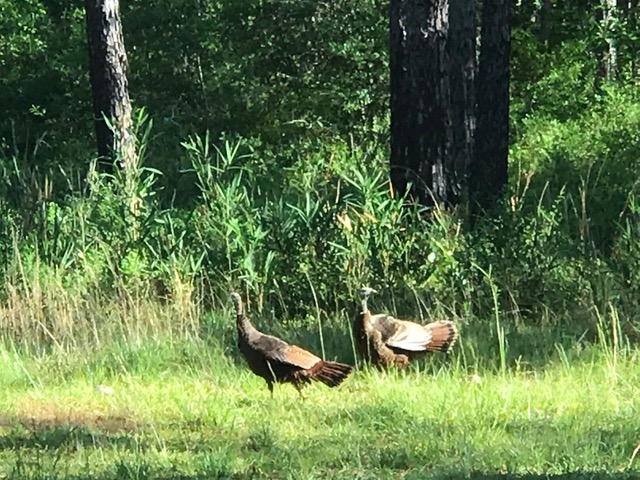
One Sunday morning in May, while drinking our coffee on the porch, Lynn and I were astonished to see two turkey hens, trailed by nine chicks, come within 30 feet of the house. They walked past the barn, the tractor, and my SUV, heads thrusting, in turkey fashion, while snatching bugs from the knee-high grass. It was such a feast, they didn’t seem to notice as I slipped in the house for my camera and later followed them on video. To hell with neatness, this was a turkey’s idea of perfect.

IMG_5017

At the rear of the house, the turkeys seemed more aware of human presence but continued to circle the building, albeit with caution.

It made me wonder why some of us, myself included, reach for perfectionism, whether in our personal lives or personal space, in the first place. (Yes, psychologists have studied the question for ages, but it took some tall grass and a lot of working from home time to bring it front and center for me.)  A friend once confessed she struggles daily trying to overcome the desire to be perfect. It’s nothing new to note, in the era of social media, she’s certainly not alone. Who doesn’t have a perfect family on Facebook, even if behind the scenes, things are a god awful mess? Instagram is filled with photographs, carefully edited and filtered to blur the imperfections. “Perfect” is the word our president tweets to describe phone calls, meetings, and anything else agreeing with his viewpoint.

Yoga has taught me that to seek perfectionism in my own life, is to let my ego get in the way of the real work. I recently joined a small group of individuals for early morning, outdoor classes with a fitness trainer. As the oldest person in the group, I often use the low-impact modification of various exercises. I have zero anxiety about the modification even as the rest of the group executes flawless jumping jacks. In my younger years, while it could result in injury, I would have chosen the high-impact option, because to do less would have meant I wasn’t good enough. In the same light, I’ve often had individuals tell me they could never practice yoga because the poses look too difficult. They believe, that to practice yoga means one must execute the poses perfectly. I’m the first to admit, after twelve years of  practicing yoga, I look nothing like the models who can touch their heels to the floor in downward dog.  The practice isn’t about reaching the floor, but rather accepting the notion it’s okay if it never happens.

Back at the camp, nature has demonstrated the seemingly imperfect, like tall, overgrown grass can produce spectacular experiences. Two Eastern Kingbirds, members of the flycatcher family, have taken up residence, plucking their meals from the overgrown field. The turkeys returned the following weekend, but without their chicks. We haven’t seen them since and when I grab the binoculars to search for signs of movement, Lynn gently suggests, like a comet in a night sky, it may have been a rare sighting. A sighting that makes for a good story and a reminder that, like the grass, we should all embrace a little messiness in our lives.

Note: As I was uploading the video below, I realized I was so excited to capture the turkeys in motion that I failed to turn the phone horizontal while shooting the video. Oops, guess I’m not perfect.

COVID Spring

Pitcher plants

Three weeks after a fire, pitcher plants thrive in the soft ground of the pine forest.

On the first day of Work from Home (WFH), I scrubbed the bathroom floor on my hands and knees, perhaps subconsciously hoping my cleaning would ward off Coronavirus. On the second day of WFH, I set my personal best on a daily four-mile walk. I can’t tell you why. Maybe I thought I could outrun the virus. Day after day, driven by some inner force, and between work tasks (the paid kind), I tackled some new chore –  weeding the flower beds, organizing the potting shed, washing windows. But after three weeks of the new normal, I was exhausted and knew it was time to trade the stress of this pandemic, not for a mop bucket or a walk around the block, but for our camp in the woods.

Feeling a bit like a criminal escaping from jail, I loaded the car and set off – looking forward to a spring drive through Mobile and Washington Counties. It’s a route that makes my head swivel as I seek small signs of nature, like the pair of osprey in their nest overlooking Mobile Bay or a spectacular display of melon-colored, native azaleas growing among a stand of hardwoods.

Our own woods offer a dozen shades of green, colors I find calming and restorative. So even though I knew it was coming, I was surprised when I arrived at our land just hours after a controlled burn. Where, that morning, the sun glinted off the verdant acres of longleaf pines, their trunks crowded with waist-high gallberry bushes, the ground was now black , tendrils of smoke still rising from charred chunks of pine lighter on the forest floor .

Controlled burn

The Longleaf pine forest still smoking after a controlled burn earlier that day.

My husband Lynn tries his best not to burn in the spring, but this year, a burn ban in the dry fall and deluge of rain in the winter, left him no choice. As I pulled through the gate, driving the road which doubles as a fire line, I couldn’t help but think a controlled burn is not unlike this COVID spring.  An instant stop to an out of balance ecosystem.

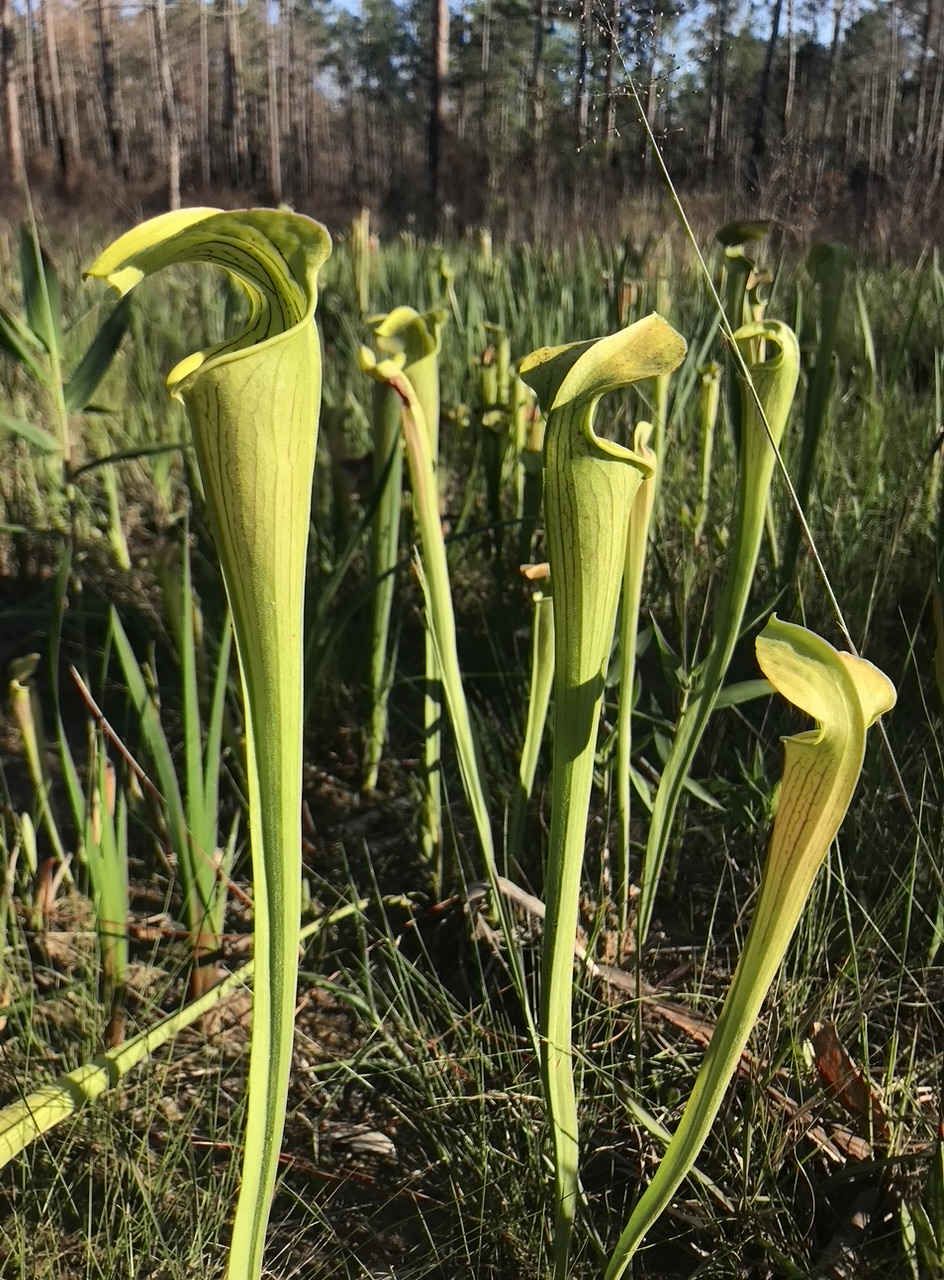
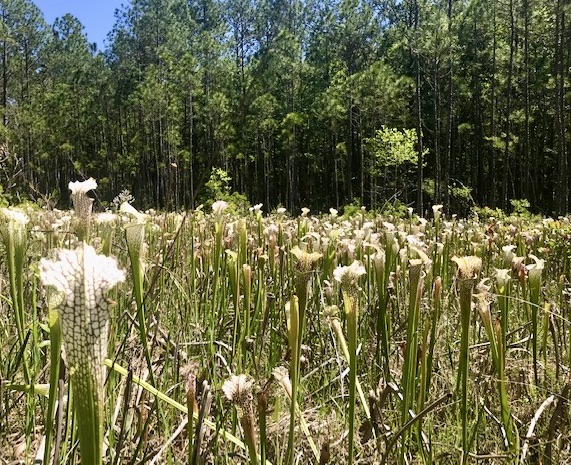
The purpose of a controlled burn is to both prevent wildfires and restore the biologically diverse plant and animal communities of the longleaf pine ecosystem. Other areas of the forest also benefit. We’re fortunate to have several pitcher plant bogs on our property, where each spring, the red-veined, tube-shaped, carnivorous Sarracenia rubra (sweet pitcher plant) push through the dirt, soft from the winter’s rain to emerge in breath taking clusters. Fire weeds out invasive wetland trees and shrubs, allowing the plants to flourish in the sun.

IMG_4806

Pitcher plants in a bog uncovered after a controlled burn several years ago.

A controlled burn lets the forest pause. And perhaps this terrible pandemic gives us pause as well. We’re compelled to think about our safety and health, but also forced to slow down to a pace that allows us to weed out unhealthy thoughts or habits. Like the forest rebalancing its ecosystem, we would do well to take this mandated stay at home order to rebalance ourselves.

I won’t go so far as to say that this pandemic will change all my bad habits and I’ll emerge a new person. Some things like an affinity to work 24/7 seem hardwired. I can’t just flip a switch and turn it off. But I’m certain, taking pause will begin to create needed change. The new normal means decelerating, looking for the smallest joys, and returning to center.

My practice began In the woods that weekend. Beyond the blackened ground, I took notice of the pitcher plants, the tiniest irises, the gopher tortoises, the blue birds, and yes, even the destructive carpenter bees. All living beings, dependent upon the forests’ regrowth.

IMG_4706

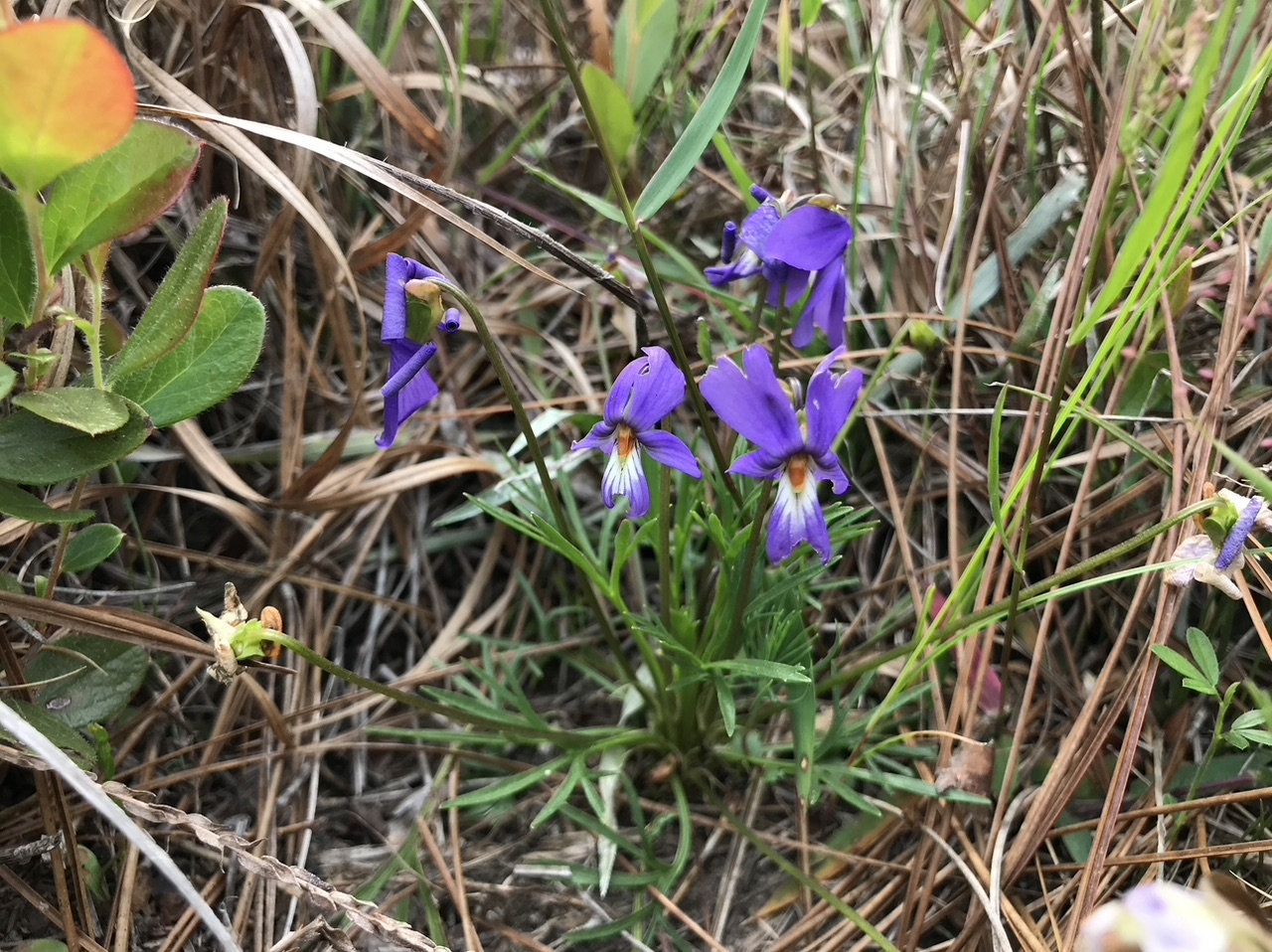
Tiny wildflowers thrive in the forest

Back home, I turned it down a notch as well. Though my “to do” list could go on and on, I set aside my expectations, no longer feeling the nagging urgency to tackle it all. The bedroom closet can wait. So can the bathroom drawer. Left with little choice but to slow down, I delighted in the magnificent  show of my backyard orchids and irises, which have poured all their energy into blooming this Covid Spring.

Car Camping

“Even a happy life cannot be without a measure of darkness, and the word happy would lose its meaning if it were not balanced by sadness. It is far better to take things as they come along, with patience and equanimity.” Carl Jung

Trail Hawk 1

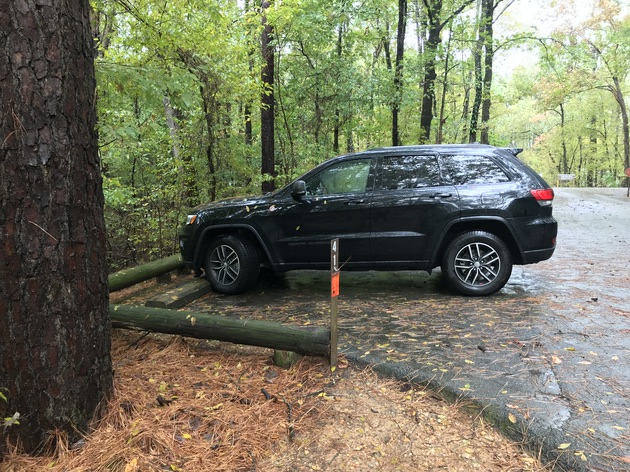
As a sales rep, I like to joke that I live out of my car. Sleeping in the vehicle elevated my relationship with the Jeep to a new level.

My mother will tell you she’s not much of a camper. Although to be fair, she’s had more outdoor experience than many. When I was very young, our family of four camped in travel trailers at state parks. Years later, when my brother and I were both out of college, she surprised us all by agreeing to a week-long, guided rafting trip on the Green River.

Given that she is more amenable to a hotel than a tent, I’ll never know what possessed my mom to volunteer for a Girl Scout camping trip to Disney’s Fort Wilderness when I was a pre-teen. To this day, we laugh while recounting the memory of her trapped in the back seat of our two-door, 1976 Pontiac Grand Prix sedan, knocking on the window for someone to let her out, because she couldn’t reach the door handle. She had chosen to sleep in the car rather than in a tent pitched on wet concrete. I can’t say that I blame her but at the tender age of 12, I’m sure I swore I would always be tough enough to choose the tent.

1976 grand prix

A 1976 Grand Prix similar to our family car. We didn’t have the T-tops, but check out the size of that door. No wonder my mother couldn’t reach the handle from the back seat.

Forty-three years later, on a warm, rainy night in Tuscaloosa, Alabama, I found myself simultaneously grumbling and laughing as I searched for inner patience and a comfortable way to stretch out in the back of my Jeep Grand Cherokee. On football weekends at The University of Alabama, we’ve discovered camping is the way to go. There’s no three-night minimum for a room and we avoid the post-game, two-hour wait for a table at a local restaurant. With a quality set of camping gear, one can experience all the comforts of home – except when it’s raining and the tent leaks.

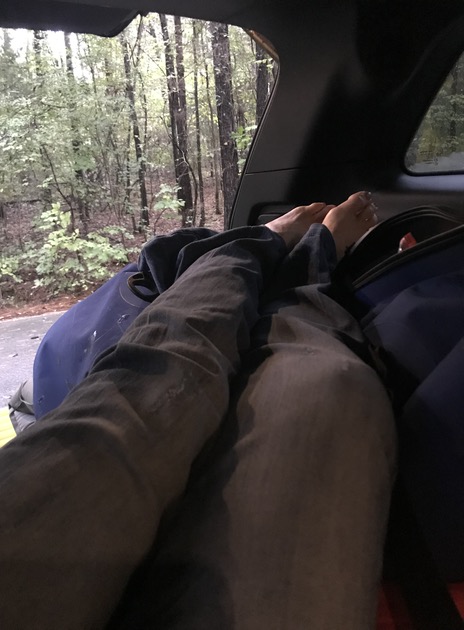
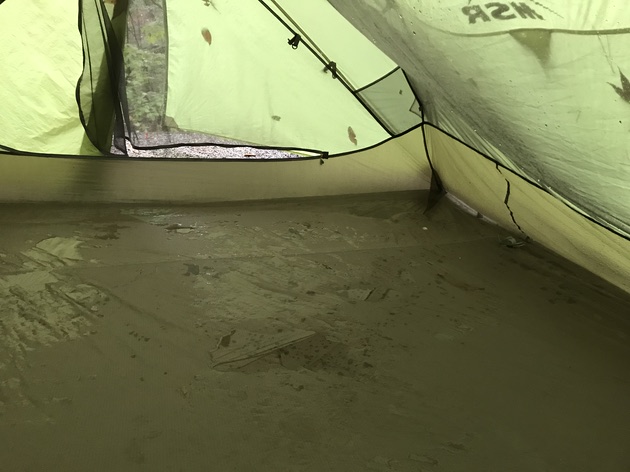
It wasn’t our first time pitching a tent in the blinding rain, but never had we noticed all those little pools of water on the inside. Lynn dried out the tent in hopes the water had dripped in during set up. We took our daughter to dinner, fingers crossed, when we returned our tent would still be dry. Of course, it wasn’t, and that’s how we found ourselves at 10 p.m., lowering the seat, cracking a window for ventilation, stuffing our dry bags into the front seat, and inflating our air mattresses in the back of the SUV. When morning arrived and Lynn pressed the button to lift the hatch, we realized we were trapped – just like my mom in the back of her Grand Prix. Laughing at the memory and the similarity, I located my keys, and opened the door with the remote, revealing sweet, dry morning air.

Lynn Bed

Lynn climbing in the car for the night.  Glad we were still smiling.

Morning stretch

Early morning stretch and clear skies.

Admittedly, at the time of the debacle, after a long week of work, it was a bit difficult to be cheery, and as Carl Jung said, “take things as they come along, with patience and equanimity.” However, it didn’t take long to realize, for us, this was one, slightly cramped night in the car. A tiny sliver of darkness in what is otherwise a very comfortable life. Sleeping in a stuffy vehicle made me appreciate the concept that, every now and then, even if it’s unexpected, it’s good to challenge one’s balance.

Certainly, it makes choosing the tent, pitched on dry ground, look that much better. I think my mom would agree.

wet tent

A tent full of water. We weren’t sleeping in that mess.

Note: Later that morning we noticed little flecks of plastic on the tent’s screen and realized the seams on the rain fly were disintegrating, causing the tent to leak. The manufacturer has since replaced the tent for free. We hope the next camping trip finds us sleeping inside a dry tent, even in a rainstorm.


House Guests


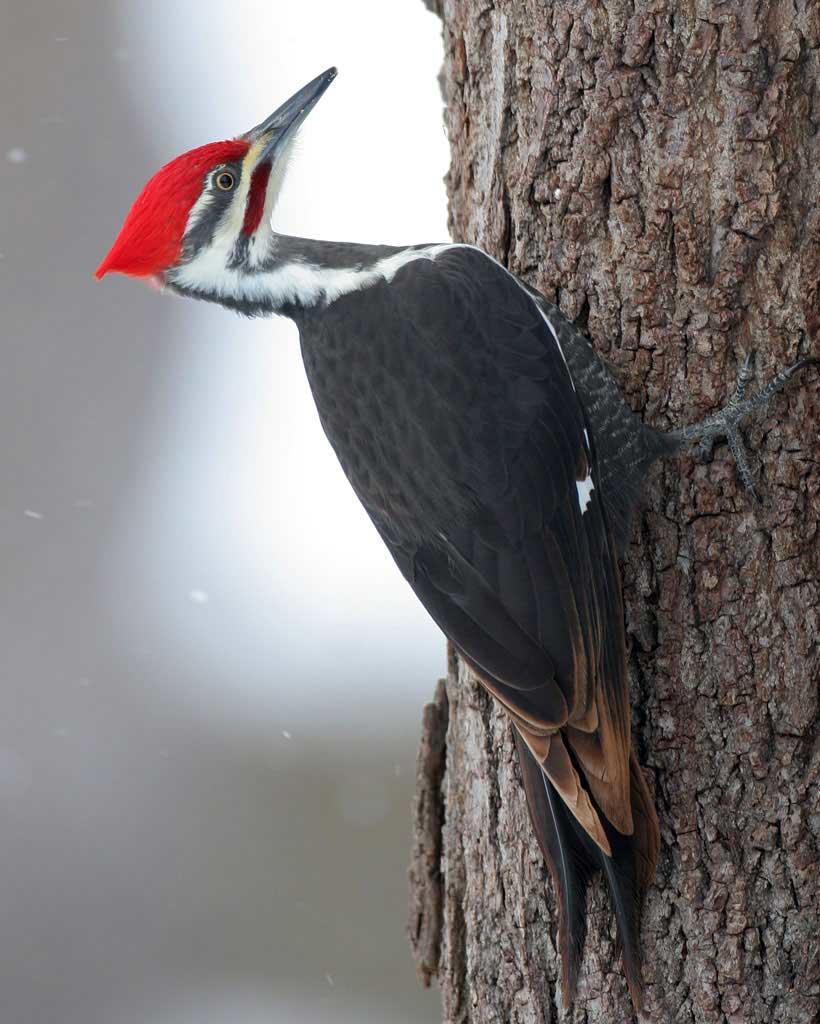
Pileated_Woodpecker_m57-4-021_l_1

Pileated Woodpecker Image courtesy Audubon Guide to North American Birds

Disruptive, unruly, messy, and unwelcome. Those are the adjective best describing our last guests to visit the camp. I wish I were describing a group of ill-mannered, young adults. They would come and go. We would clean up and make a mental note not to have them back to our little corner of solitude. But these house guests, a pair of pileated woodpeckers, arrived uninvited.

IMG_3868

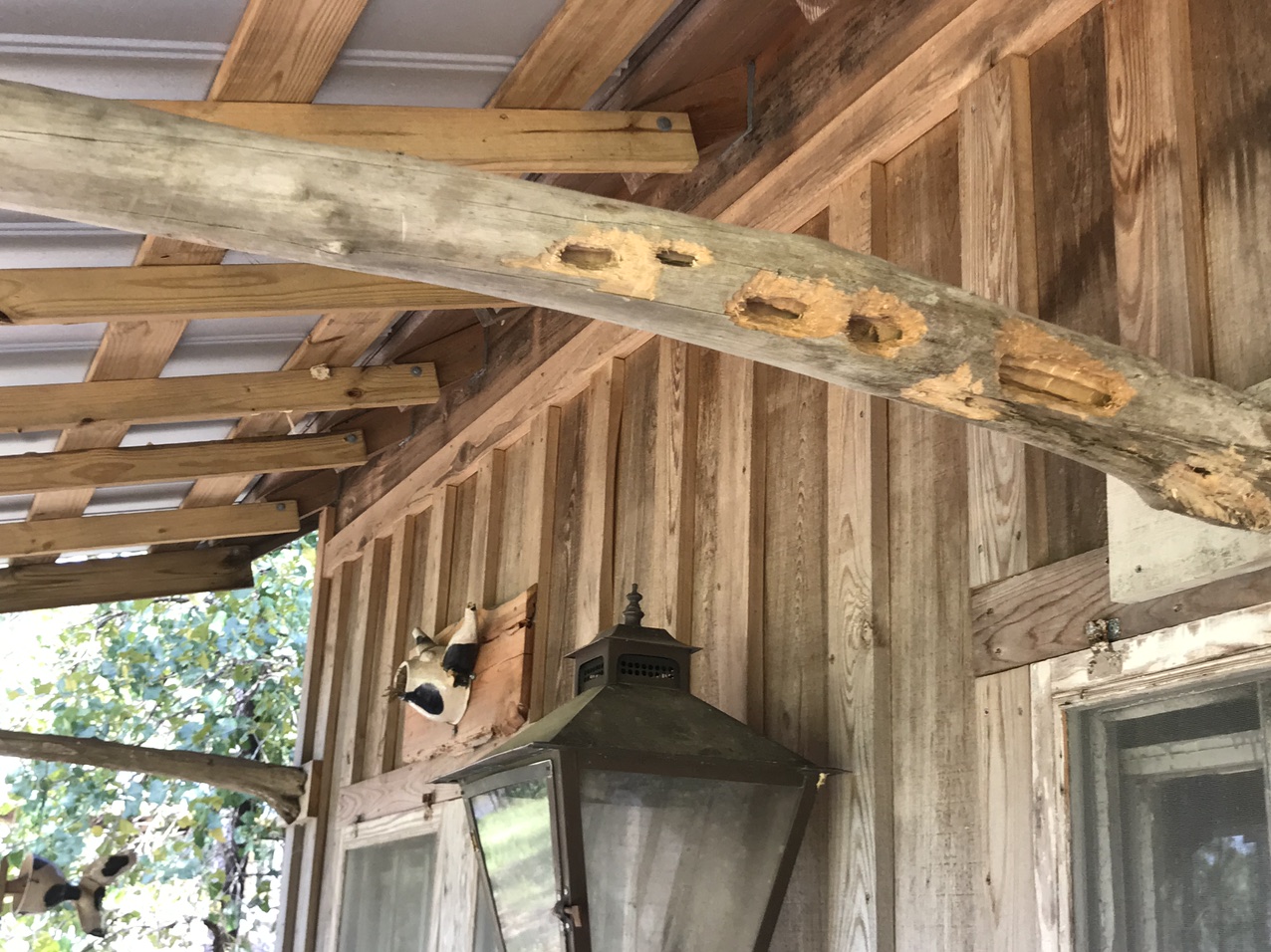
A cypress porch beam damaged by woodpeckers looking for carpenter bee larvae.

It was the second year in a row the largest, known surviving species of the woodpecker family paid a visit to the camp. In fact, to every building on our property. A spectacularly, large bird with a flaming red crest, and a long sticky tongue, it’s a thrill to catch a glimpse of the pileated woodpecker and hear its repetitious call in the woods surrounding our lake. Described in our Golden 1983 edition “Birds of North America” as “uncommon; a wary bird of extensive deciduous or mixed forests,” the federally protected, Dryocopus pileatus, only visits when we’re away. It is not a thrill to find the aftermath of their destruction in the beams, trim, and cypress siding of our camp house where Lynn proudly, hand-picked every cross-beam for the front and back porches.

To be fair, we should have expected the birds. One might suggest we even rolled out the welcome mat. Lynn and his father have spent years rehabilitating the woods, once clear cut for the Alabama timber industry’s insatiable appetite, to create a habitat for native species of plants, animals, and insects. A third generation of Longleaf pines now reaches for the sky, the trees’ sturdy trunks and branches the perfect forest for the pileated woodpecker. A combination of lightning strikes and prescribed burns has left a smorgasbord of standing, dead wood, ideal for the birds’ survival.

IMG_3846

A lightening strike created a home for woodpeckers in this longleaf pine. Look closely to see the small redheaded woodpecker on lower right branch.

Our tree-farm is also well suited to the carpenter bee, a quarter-size, black and yellow striped, hover craft of an insect with a distinctively loud buzz. Carpenter bees drill dime-size, perfectly symmetrical, holes in wood, seemingly any wood – cypress, juniper, cedar, even chemically treated “yella wood” to name a few. Deep in these cylindrical tunnels, the bee deposits its eggs, which hatch as larvae and must taste to the pileated woodpecker like a fine piece of Belgium chocolate tastes to the discriminate human palette.

IMG_2080

An old piece of cypress siding exhibits an example of the dime-size tunnels created by carpenter bees.

For years, we told our children not to fuss when the carpenter bees hovered around their heads and faces, perhaps mistaking the hue of recently acquired summer freckles for a former home. Leave them alone and they won’t sting was our oft-repeated mantra. And herein lies our conundrum. Long before I practiced yoga, we always believed all beings deserved to walk, crawl or fly through the world with ease. As I’ve written in this space before, we are those people who rescue spiders and other insects from inside our home, setting them free outdoors. (Case in point, recently I drove 30 mph on a busy highway until I could pull over and safely deposit the tree frog who had hitched a ride on my car’s side view mirror.)

We allowed the healthy bee population to drill their holes in our camp’s exterior wood and our hand-crafted, porch furniture. Living in harmony with these pollinators worked. Until it didn’t. Clearly the birds knew they were safe to move in when we were gone. Near every tunnel the bees created, the majestic birds tore long, splintering gashes in the wood to reach their prey. They attacked the beams, the floor boards, and in one very personal case, the pair hacked a hole in the seat of Lynn’s favorite Adirondack chair.

IMG_3870

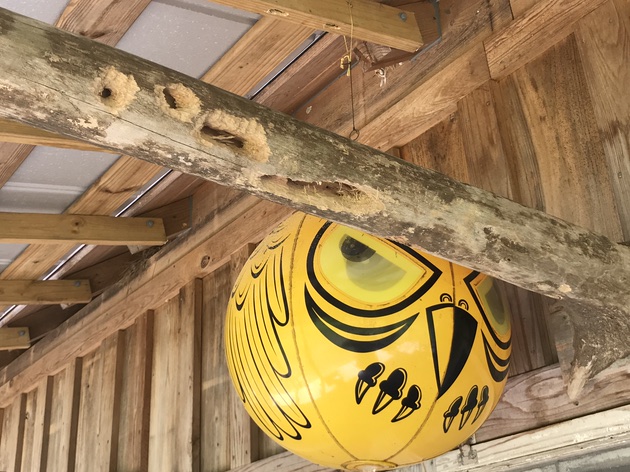
An orange ball with hologram eyes stands guard against the woodpeckers.

So what to do about the birds and bees? The oft given answer “shoot em” was not an option. In keeping with both our environmental and peaceful lifestyle, Lynn tried other methods to deter the birds. He hung giant orange beach balls like those used by NASA to scare birds away from launch pads. The balls had angry faces with hologram eyes that moved when the wind blew. Owl and hawk decoys were repositioned to stand guard and a trap designed to lower the carpenter bee population hung from the porch beams.

Sadly, nothing was a deterrent for long. Research shows eliminating the bee larvae is the most practical solution to keeping the birds away. It brings us to the age-old dilemma of man versus nature. To ease our minds, we’d like to think we’ll simply be encouraging the bees to make their homes in dead wood provided by the forest – not the lumber mill. If successful, next spring, we’ll sit on the porch in our favorite Adirondack chairs, binoculars in hand, and watch the birds and the bees from afar.

To learn more about the pileated woodpecker or to hear its call, visit The Cornell Lab of Ornithology All About Birds. 


Intact Community

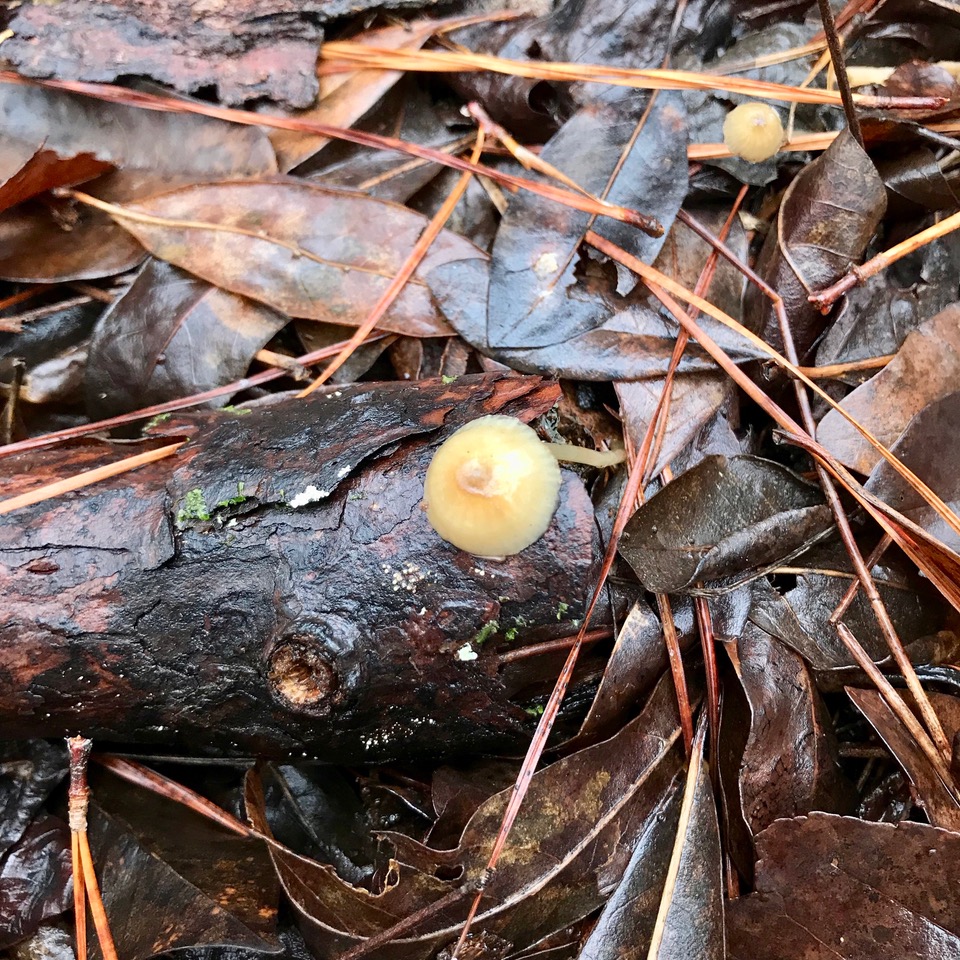
IMG_2986

One of many varieties of mushrooms found in the woods of Washington County, Alabama.

Except to buy the occasional button, portobello, or porcini at the supermarket, I’ve never paid much attention to mushrooms. Certainly, the idea I could learn a lesson from how mushrooms grow in the wild never entered my thoughts. But thanks to a trip to Spain last fall, mushrooms were suddenly on my radar. During a daylong tour of Basque country, our guide Jon kept a keen eye out for truffles hidden in the grass along the winding road. He assured us it would be both safe and thrilling to have a taste of the elusive morels.

IMG_2645

Edible mushrooms for sale in the market in Spain’s Basque country.

We were unsuccessful in our hunt but the thought of foraging rekindled a spark in Lynn’s wilderness repertoire. What if we could find edible mushrooms in our own south Alabama woods? Could we be so lucky to find morels resembling the gorgeous displays of golden and brown fungi in Spain’s markets? On previous hunts, every mushroom we discovered was matched with skull and crossbones in the field guide book. It had been a wet month, perhaps this time would be different.

Our search for edibles was again unsuccessful but I marveled at the large number of varieties we found. Once we started looking, mushrooms appeared every few feet. Where there was one, there were many. They were shaped like golden stars, pink, glossy buttons, turkey tails, and tiny oyster shells. Better yet, while each plant stood alone, it grew in its own intact community with like varieties circling in clusters around the roots of a tree or attached to a decaying log.

It was a nice metaphor as my own daughters venture out into their adult lives. As humans, we’re born into a community of family, people who care, nurture, and circle around us, shaping our young lives. While that community never truly leaves us, later we forage for new friends who share our ideas, interests, and values. When we move to a new town whether for college or for that first job, we must search for that intact community. We must find “our people.” An old friend recently told Lynn and me it was the most difficult thing she had to do when she moved cross country for a job change.

As we all know, searching for community can be intimidating and scary. Yoga taught me it takes self-discipline to put oneself out there and embrace the discomfort that comes from the unknown. To do so and choose our friends wisely is a tall order. But as the saying goes, “you are the company you keep.” It can take a while to find “our people,” and the understanding that while we connect with those individuals who think and look like we do, not all relationships will endure. A look at our wedding album reveals just how much my own friendships have shifted over the years. It’s my hope, as their lives progress, our daughters will have the strength to stand alone, but also rely on a shifting circle of friends who shower them with positive influences.

Who knew foraging for mushrooms could generate such insight?

Now is Here

Now is Here

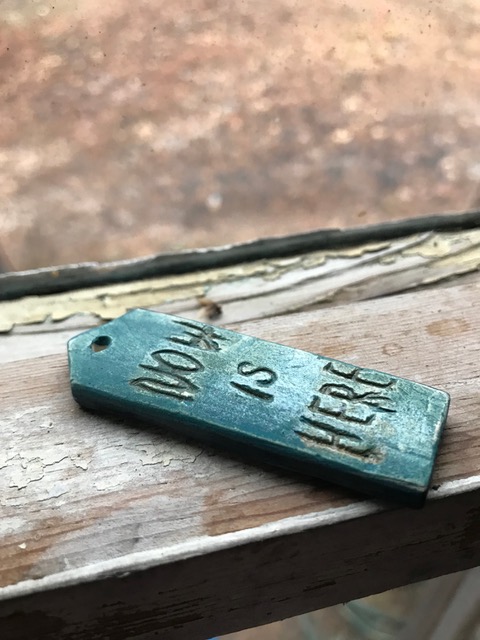
A reminder to stay present rests on the camp kitchen window sill.

“Now is Here.” That’s the advice our friend, the late artist Fred Marchman, scratched into a tiny rectangle of clay.  The creation may have been Fred’s way of doodling, not unlike the musings he wrote on his many block prints. The saying, which I sometimes transpose to “here is now,” hangs in the kitchen window of our camp house, reminding me to stay present and pay attention to nature’s gifts.

“Now is Here,” surfaced in my mind on a recent five-day canoe trip through Alabama’s Mobile-Tensaw Delta, a broad river valley terminating at the head of Mobile Bay and home to some of the most diverse wildlife in Alabama. My husband Lynn teaches a wilderness medicine elective to fourth-year medical students, training them to respond to natural disaster and humanitarian crises. The course culminates with a week-long paddle in the Delta, where students practice their skills without the modern comforts of home.

IMG_3364

Lynn leads the expedition, following paper maps to navigate and tracking the water ways with a GPS for backup.

I went along for the ride this time, in part to lend experience, and in part, because one of the joys of a river trip, is disconnecting from the constraints of time and technology – being fully present with nature. On our very first paddle, twenty years ago, that meant putting away your analog watch and living on river time. Today, with smart phones doubling as cameras, living fully present, at a minimum, requires turning off one’s cellular data, disabling the apps and wireless accoutrements accompanying the phone – not always an easy task for those of us who check our devices more than we care to admit.

IMG_3296

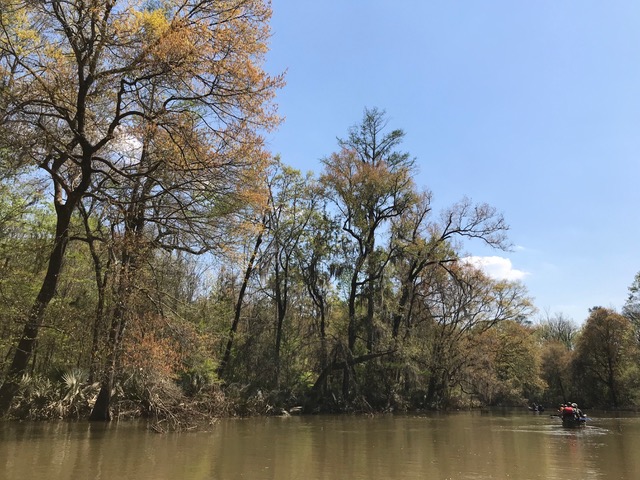
Mother nature greeted us with clear, blue skies and bald cypress trees brimming with spring color.


From day one of the expedition, it was easy to see how many members of our team couldn’t fully disconnect. Smartphones were omnipresent. I was no exception, turning on my cellular data when in range of a tower, to check for an important email I feared I would miss. Instead, I felt as if I had cheated myself. We were violating Asteya, one of yoga’s Yamas, or ethical guidelines. Asteya translates to non-stealing. In this instance, it felt as if we were robbing ourselves from being squarely present with nature, stealing our teammates’ rights to a digital free week, and failing to pay full attention to one another.  While being tuned into the device, rather than the river, who missed the cacophony of scolding ospreys as we paddled close to their nests? How about the the splash of the water moccasin as it slipped from the tree into the river? Did digital distraction steal the natural sounds of the laughing gulls, flocked together and mocking us from the shoreline?

IMG_3378

A young gator sun himself at the edge of small creek.

It will be another year before I spend a full five days in the Delta. My yoga teacher often uses the quote, “We can’t go back and start over, but we can begin again.”  This time, I’ll forgive myself for stealing from the experience. For compassion is also part of practicing yoga. I’ll begin again, learn from the discomfort, put away my own device and strongly discourage others from bringing technology as well. I’ll slip everyone a piece a paper with the saying “Now is Here” and in the true meaning of being present, we’ll watch, undistracted, as bald eagles soar against the backdrop of a bright, blue sky.