Safe Mistakes

img_3066

“As you go the way of life you will see a great chasm. Jump. It’s not as wide as you think.”                                                                                                           Joseph Campbell (1904-1987)

I’ll never aspire to be a circus performer but a year ago, I challenged myself to begin practicing aerial yoga. It took three years to talk myself into making the leap from a grounded practice to one that includes silk fabrics hanging from rigging points high above the floor.  While the fabric itself isn’t far from the ground, I pictured myself breaking my neck rather than gracefully executing the poses. It’s a common theme among the nay-saying crowd who endorse the notion they’re too inflexible, old, weak, or afraid to give aerial a try. Working up the nerve, and determined to fix my persistent low back pain, I bought a class package, announcing at my first session, “I would like to find my abs.”

I found my abs, my back is better, and I continue to practice, in part because like any yoga, aerial teaches lessons I can apply to other parts of my life. One recent Thursday, prior to class, my teacher Megrez Mosher (who was a circus performer and can gracefully execute the poses) was talking about safe mistakes. That is, the permission to try something unfamiliar, perhaps make a mistake, but come to no harm. She mentioned how she no longer hovers near more experienced students because, while not experts, they’ve built confidence and have what she calls an “exit plan.” They are free to experiment, work toward the pose, and make safe mistakes.

img_1046

Megrez Mosher spots me long enough to take a photo.

While one must be willing to jump, the theory of safe mistakes can and does apply to camping as well. Fully experiencing nature, far from the distractions of work, school, and the digital world, not only takes practice but also trial and error. So often we hear, “I could never go camping. I like my own bed with the comforts of home.” But how can one dismiss sleeping outdoors if you’ve never known the pleasure of slumbering on a truly, great air mattress?

img_1028

Like Yoga, dinner around the campfire just gets better with practice.

In two-weeks, my husband Lynn and I will teach a new group of fourth-year medical students wilderness medicine. The elective entails not only learning how to treat patients without the convenience of a hospital nearby but also how to take care of oneself in a backcountry setting. Very few of the students have outdoor experience and it’s easy to predict the course will propagate a fair number of safe-mistakes. In the most dangerous situations, the instructors will be there to spot their students. However, no one will die if it takes ten matches to start a campfire, if dinner on the propane stove is a flop, if a group takes a wrong turn and is forced to paddle against the current, or if someone goes for an unexpected swim in cotton rather than nylon underwear. For certain, it could be uncomfortable. It’s the self-discipline to work through the discomfort, to return again and again, to learn from our safe mistakes, that eventually brings delight and skill to the outdoor experience.

Like yoga, enjoying the outdoors is a practice. What’s holding you back?

Go ahead. Jump. The woods are waiting.

img_0982

Students polish moving water skills while readying to camp in the Mobile-Tensaw Delta.


The Juliette


IMG_1723 2

The Juliette, a 1960s Grumman aluminum canoe.


We like to joke we acquired an armada of boats this summer – the kind powered by paddling.

My husband Lynn can claim the sea kayaks and fancy, feather-weight canoes. My favorite is a hulking, 1960s Grumman canoe purchased from a friend who was downsizing. As a little girl, my friend and her brothers learned to paddle in this boat, but for me it would offer a different kind of lesson.

A 17-foot-long aluminum craft, the Grumman reminds me of the canoes I paddled in both my childhood and adult years in Girl Scouts – first as an 11-year-old floating down Florida’s Withlacoochee River and later as a leader teaching Brownies to navigate our favorite scout camp lake. I couldn’t help but name her “The Juliette” after Girl Scout founder Juliette Gordon Low.

The Juliette has a wide frame and maintains a graceful balance as she glides across the lake at our camp. It’s easy to straighten her bow and point her in the right direction, avoiding obstacles where she could easily get hung up. The water’s rhythmic slapping against Juliette’s hull produces a soothing sound, one that generated my ah ha moment.

IMG_2900

The Juliette’s maiden voyage in Washington County, Alabama.

My youngest daughter and I took The Juliette on its maiden voyage this summer. We spent the night at the camp on our way home from a long day of packing up her college apartment, readying her to study abroad this fall.

On the lake, fresh from the moving frenzy, and unplugged from Wi-Fi, LTE, and the power grid in general, I quickly saw The Juliette as a metaphor for creating balance in my own life. Caught up in the rush and competition of daily work, piloting the logistics of family life, and frustrated from listening to the angry rancor of opposing political views that seem omnipresent, I had forgotten how to relax and have fun. Even returning to my yoga practice, whether grounded or aerial, I couldn’t seem to shake the feeling my life was far out of balance, sprinting from one task to another, sun up to sun down, only to repeat the cycle the next day.

At some point between a week-long business trip and the drudgery of laundry, I announced to my husband I needed a weekend at the camp. Ironically, it was three weeks before we could fit it into the schedule. Tempted to invite friends, we resisted, not because we didn’t want to share, but because this weekend was about sleeping in, paddling The Juliette on the lake, fishing, listening to birds, reading, walking through the woods, writing, and hitting the reset button. Full disclosure – Lynn cranked the generator, plugged in a television, and watched a little Alabama football too.

IMG_8684 2

Alabama vs Tennessee – camping style.

We’re both driven individuals, and it’s difficult to flip the switch from work to play. We’ve learned escaping to the woods is often the most mindful way to change directions. Thanks, Juliette, for the memories and the metaphor.

IMG_3493 2

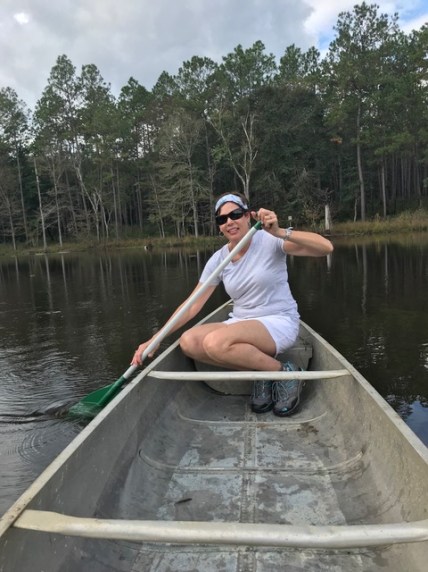
A peaceful paddle on the lake. My reminder to slow down.


Noodle Drop

This post is dedicated to my yoga teacher, Augusta Kantra. I am grateful for your practice, your dedication, and for 10 memorable years of Saturday morning yoga. 

IMG_7473

The Chickasawhay River in Mississippi

July makes me nostalgic for river trips. For seven years running, before summer jobs, college, and the real world lured away our children, our family would choose a long July weekend to paddle a winding river on the Gulf Coast. Our entourage always included close friends — other families and teens — craving adventure and a few days spent, round the clock in bathing suits. The daily routine went something like this: coffee at sunrise, paddle 10-15 miles, hold frequent swim breaks, set up camp on a wide sandbar in the river’s curve, and conclude with a gourmet dinner and campfire.

While the point of a river trip is to get away from electronics and into nature, there is an art to bringing the proper gear so that everyone is comfortable. That responsibility always falls to my husband Lynn. In part because he loves it and in part because a childhood spent in Scouting left him gifted in planning and logistics.

When it comes to outdoor equipment Lynn is something of a gearhead. He takes great delight in not only seeking out the finest new gear, but also in fiddling with a broken camp stove, patching the hull of a canoe, or outfitting the perfect kitchen box. Although, we’ve learned from a soggy experience, it’s best to replace rather than patch a leaking tent, almost nothing gets thrown away until it’s used up.

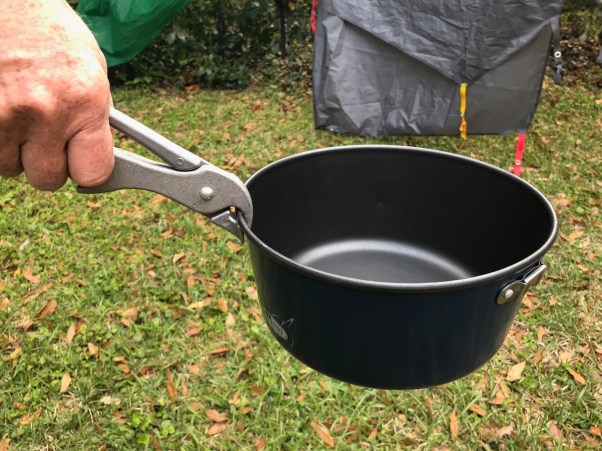
Like a favorite shirt or a child’s prized toy, it’s easy to get attached to camping gear. The old aluminum percolator smells like camp on winter afternoon. The grip on my wooden paddle evokes memories of teaching little girls to canoe. And for Lynn, a certain pair of pot grippers brought back images of childhood Scout trips – until they didn’t. (For non-camping readers, pot grippers are just what they sound like, a handle used to pick up a hot pot.)

IMG_1069

Camp cook kits come without handles for easy storage. Pot grippers are a must for handling hot pots.

One of our go-to camp meals is pasta and chickpeas. Of course, after it’s boiled, the pasta requires draining, which is where pot grippers come in handy. On our last river trip, Lynn used his faithful pot grippers to carry the noodles to the river’s edge, where the appliance failed, landing the noodles in the sand. A few curse words later, we picked up the noodles, rinsed them off, and brought them back to the cook table where I promptly dropped them in the sand. Rinse and repeat, as the weatherman says. We all ate a little grit that night and laughed that it was good for our digestion.

IMG_7405

Though not the night of the noodle drop, this is a typical kitchen set up on a river trip.

After the trip, I was sure we had retired the pot grippers. But a couple years later, during a camping trip in Tuscaloosa, the noodle drop repeated itself, only this time with potatoes on a gravel camping pad. Following a second gritty meal, it was time for those pot grippers to go.

Yoga has taught me there’s no use hanging on to something that no longer serves us well, whether it’s a thought, a relationship, a closet of unworn clothing, or in this case, pot grippers with edges slick from years of use. We can choose our freedom, walk down a different road, and not repeat our mistakes. Following the potato episode, I bought Lynn a new pair of pot grippers. Each time we use them, I’m reminded of our July river trips, but also of the lesson, sometimes you need to eat a little grit to finally let go.

IMG_1067

New pot grippers for the kitchen box.

Lo Siento

I am (Deeply) Sorry

 Just 14 days after we departed a camping trip in Guatemala, Feugo Volcano erupted with its most violent force in four decades. At the time of this post, its pyroclastic flows had claimed the lives of 110 people, with almost 200 more still missing. For Guatemalans living in the Volcano’s shadow, the sounds and sights of Fuego’s daily eruptions are commonplace. Though we camped more than 10 miles away, we often heard the distant rumble and viewed the black plumes spewing upward as the active volcano flared. We are deeply sorry for the people of Guatemala who treated us with such warm hospitality during our stay.  

It was just one short article in the travel section of The New York Times last December. The headline, “With Mobile Camping, Remote Places and Light Footprints” was enough to catch Lynn’s eye. We were tossing around the idea of a vacation with our girls to celebrate our oldest daughter Annie’s graduation from college. The girls wanted a beach in Costa Rica. Lynn and I wanted something a little more active.  Among other out of the way places to camp, the article mentioned trekking in Guatemala. Might be an interesting compromise we thought and shelved the paper in a basket of magazines in the central hall. Four months later we dug it out of the basket. In mid-May, destined for the “best family vacation ever” we were on a plane to Guatemala.

Tents at Sunrise

Tents at Sunrise.

Glamping is not usually our thing. What’s the challenge in camping if you don’t set up your own tent at night or tackle the task of an epicurean meal with one can of propane and two small burners? But here we were, signing up for a trip with canvas tents, cushy air mattresses, gourmet meals, someone to lug our gear from one campsite to the next, and yes, even a toilet. I secretly enjoyed the thought of carrying only a day pack. After all, I already had to be “that lady,” hiking up and down the hill to the Fairhope pier breaking in my size 10 boots, and didn’t want to add more attention by training with a giant pack on my back.

IMG_1443

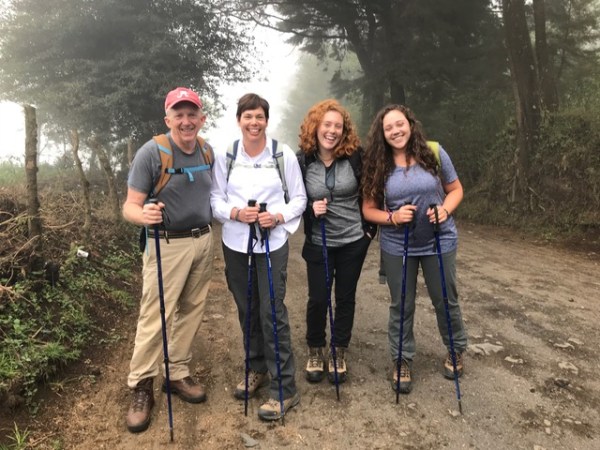
Day one at the Trailhead.

We arrived in Guatemala after navigating the first of the month at breakneck speed. Work for us, final exams for the girls, Annie’s graduation celebration with family, culling “things” collected in college, and moving the rest back home. In between, we squeezed in what exercise we could in preparation for the trip. Our lives are spent in the low lands of coastal Alabama, elevation 112 ft., and there was no way we could adequately train for Guatemala’s altitude. The trailhead would begin at 7500 ft. with the highest point of the trek topping 9000 ft. According to the planned route, in between camps, the trail would rise and dip with the mountains, leading us through tiny Mayan communities and acres of fertile farmland.

We quickly made friends with our trekking family which expanded beyond the four of us to include the owner of Trek Guatemala, a native Guatemalan guide, and two adventure tour agents gaining first-hand knowledge of the glamping experience before selling it to clients. On days two through four, local guides hired from communities along the trail, would also accompany us.

IMG_1480

A map of the trek route hangs in the dining tent so that hikers can see the ups and downs of each day’s progress.

We began our trek easily enough, in high spirits, on a wide flat road with a mist from incoming clouds. Every twist and turn was a photo opportunity – wild roses decorating the roadside, lush forests shrouded in cloud cover, and farmers carrying bundles of leafy foliage gathered to feed hungry bovine. Day one’s uphill ascent was challenging but not impossible, offering a chance to acclimate with fewer miles to traverse. I dug in my trekking poles and accepted helpful tips on breathing for the altitude – Pranayama for the hiker, if you will, to oxygenate my blood.

IMG_2455

A farmer gathers foliage to feed his cows. Photo courtesy Lynn Yonge

Day two was another matter. Early on in our trip, our youngest daughter Genna, who has a second college major in Spanish, schooled us in the difference between lo siento meaning “I am deeply sorry” and perdóname, an informal apology.  The former she said, is often used incorrectly. But day two of our trek would find those words slipping through my brain and off my tongue like a native speaker. On the map, our route looked like a rollercoaster. First uphill, then a long downhill descent to a hanging bridge, followed by the steep uphill stretch to Fuego Camp. Still in great spirits, but not yet acclimated, I seriously questioned my ability to keep pace on the first uphill leg of the day’s journey. I lagged behind, offering apologies to my trekking family. As we snaked up the long hill single-file, I silently counted my footsteps, thinking it would at least help me mark the progress. My breath sounded ridiculously loud in my ears until at some point, my yoga practice kicked in.  In yoga, I thought to myself, I move toward the pose, not afraid to admit, after ten years of practice, I still can’t touch my toes. But here on the mountain, I felt as if I needed to preface my desire for every break with lo siento. Finally, I announced, “I’m not afraid to say it, I need to stop.”  Equally winded from the climb, other members of our trekking party enthusiastically embraced the rest.

DSC02358

Taking a break on the trail.

While it took four days of hiking to truly feel acclimated to the altitude, I soon accepted my willingness to move toward my goal of accomplishing the day’s miles, while laughing about frequent rests, rather than conquer the challenge in misery. Un momento, por favor (hold on, please), I said to our local guide at nearly every S curve. He patiently agreed, even offering to carry my daypack to make my climb easier. I gladly handed over the pack, grateful for both his help and the ability to recognize that my limitations don’t always call for “lo siento.”

IMG_1551
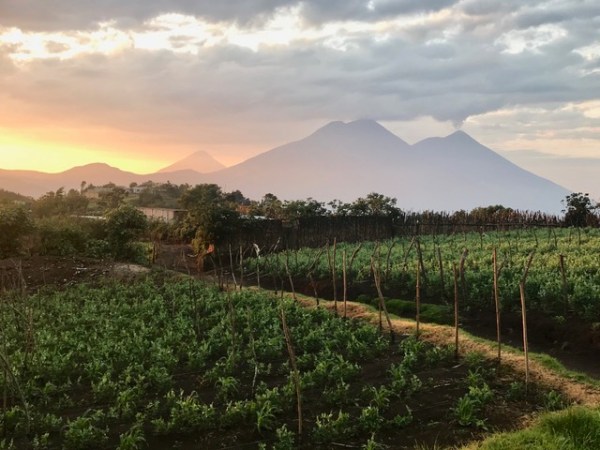
Sunrise view of Fuego Volcano from the Trek Guatemala campsite on day two.

Inspired to go glamping in Guatemala? Contact one of these three companies to find out more information and plan your trip.

Trek Guatemala

Root Adventures

Maya Trails


Muck Boots

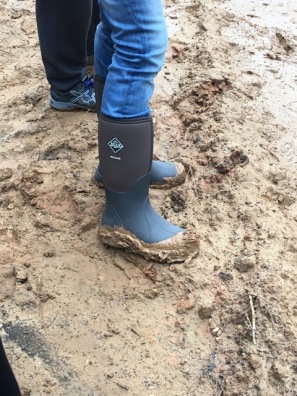
For my 50th birthday, my husband took me to Paris. On my 51st, he bought me muck boots. The gift was by request, much like my first technical rain jacket, he purchased years before. The boots are tall and brown, perfect for strolling through the bottomland after a heavy rain, and equally handy for stepping out on the dirt road when the dusty, orange clay turns to thick, sticky mud. Which is exactly what I feared would happen last weekend.

muck boot photo

The girls were bringing friends to the camp for a couple days of fun before the end of the college semester and graduation. Lynn and I invited our close friends and their guests to join us for the day on Saturday. Entertaining off the grid is more preparation than talent. With illusions of throwing an event worthy of being featured in Garden & Gun magazine, I set to work planning menus, grocery shopping, and gathering supplies. Lynn ordered pounds of shrimp, potatoes, and corn, and brought out the 15-gallon pot for boiling.

As the week progressed, we kept a keen eye on the weather. When you live near the rainiest city in the country, thunder storms are common and often move through quickly. But when your entertainment venue can only be reached by a narrow, dirt road, a high chance of a gully washer is reason to cancel. For some freak of nature, rain is always in the short-range forecast when we plan to have guests at the camp. I’ve lost count of how many times we’ve had to call it off.

As Friday morning dawned, I opening the weather app on my phone every hour or so, hoping mother nature had a change of heart. But no, it read like this:

   Today, Mostly Cloudy, Precipitation 10 percent;

  Saturday, Strong Storms, Precipitation 90 percent;

  Sunday, Partly Cloudy, Precipitation 10 percent.

The forecast for the remainder of the week was sunny. I found myself putting “damn it” at the end of every thought. “Why does this always happen, damn it?” “When’s the best time to call it off, damn it?” “We’re going to have so much food left over, damn it.”  “It’s just not fair, damn it.” In so many ways, letting go was not going to be easy.

weather forecast

Our friend called, “Have you seen the forecast?” he asked. We spent the better part of 30 minutes debating the best time to cancel. “We’re worried about y’all driving on the dirt road after a heavy rain,” I explained. “I have muck boots and four-wheel drive.” We both agreed muck boots were not a staple in their wardrobes. Although, he suggested it would make a good title for a blog post.

That afternoon I packed my bag and my ego and headed for Washington County. Though the weather called for rain, I looked forward to quality time with my family. When a partly sunny Saturday morning arrived, I renewed my frustration with the weather gods and doubted our decision to put off the picture-perfect party. The girls spent the morning fishing and as I settled into a comfortable camp routine, I changed my perspective, and my attitude, enjoying the moment and making new plans for the extra food we would take home.

We downsized the shrimp boil to feed eight and used a clean garbage can lid, not a fancy platter to serve. From the smiles on the college students’ faces, and our girls’ gratitude for the hospitality, I’d say it was still a magazine-worthy event.

Processed with VSCO with f2 preset

Shortly after clean-up, like a train on schedule, a record amount of rain came roaring through. At peace with our decision to cancel the party, we took a nap…to the rhythmic hum of rain on the tin roof.


Home Wreckers

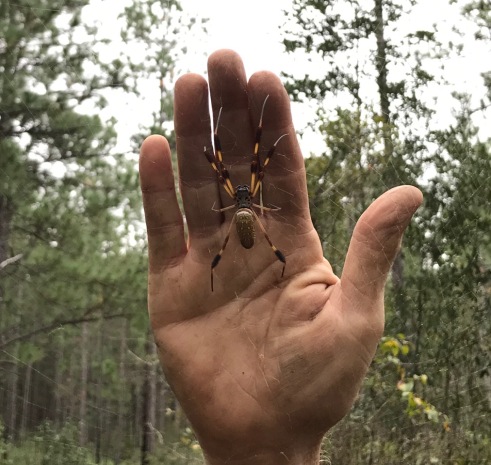
We once had a golden orb spider as a pet. She made her home high in the corner by the back door and my daughters, then in elementary school, watched her daily, secretly hoping they had their own Charlotte who would spin adjectives such as “radiant” and “humble” into her web. We all cried the day the pest control man killed our friend, sweeping her away with a long-handled broom, oblivious to the joy and wonder she brought our family.

IMG_0462


The story has stayed with us, and so some ten years later, I never imagined we would become home wreckers of not just one, but at least a dozen golden orb spiders living in the woods of Washington County, Alabama. The land is ours, a Treasure Forest my husband Lynn manages on his days off and a place where he and his father can enjoy time together. Sitting high on a tractor, my 86-year-old father-in-law grooms wide paths among the trees, opening fire lines and leading us to green fields where gopher tortoises dig their burrows and blue birds nest in boxes atop metal poles. The paths are also the perfect habitat for the golden orb spider. Clinging to longleaf pines and yaupon holly on either side of the trail, the spiders stretch their yellow-hued webs, head-high across the grassy track.

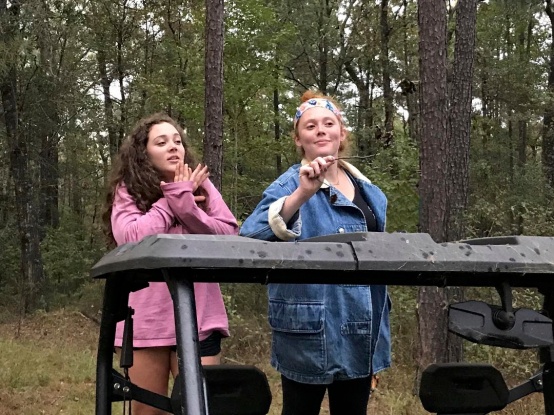
Such were the webs when we found ourselves riding through the woods on a beautiful autumn day in October. Our daughters Annie and Genna had arrived from The University of Alabama for fall break and we were all craving a little family time off the grid. “Who wants to go for a ride?” Lynn asked, backing out the UTV, brushing the dirt out of its utility bin, and indicating for us to hop in. I took the front seat with the girls choosing to hang on in back. We weren’t far down the path when the shrieking began. The spider webs, at first invisible, were perfect targets for the roof of the UTV where the poor spiders found themselves unexpectedly homeless and face to face with our daughters. Both girls are veteran campers, Outward Bound graduates, and former camp counselors, and I was surprised to see the level of fright on Genna’s face.  Surely these were not her first spider encounters.

Girls

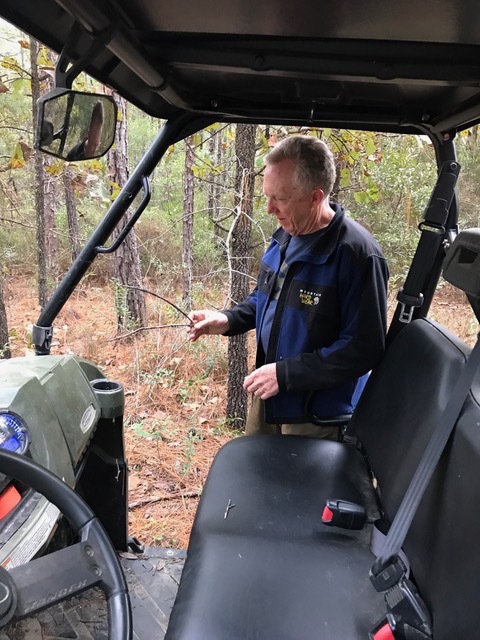
Suddenly, these tiny creatures, whose size equaled less than one percent of an adult’s body surface area, thrust us into familiar family dynamics. As if they were little girls again, Annie, fully aware Genna was terrified of getting the spider tangled in her long, curly hair, taunted Genna with a two-inch insect on the end of a stick. I tried the cliché “you’re bigger than it is, the spider won’t hurt you,” and Lynn calmly relocated each spider to the side of the path.

Lynn with spider

The situation called for a healthy dose of compassion in more ways than one. Where others, like our old pest control man, might have killed the spiders, we wished for them only a safer place to live. Annie saw the terror in Genna’s face and let up on the teasing, showing a little compassion toward her sibling.  I stopped trying to talk Genna out of her fear (in truth, I shrieked at the thought the spider landing in my hair) and she accepted her panic with grace, exclaiming at the end of the ride, “That was both terrifying and fun.”


The Beginning

Summer 2004 040

I am no stranger to camping in the South. A Girl Scout since the age of eight, I can pitch a tent in blinding rain and know enough about sleeping in the southern woods to shake out my shoes each morning. But the day my husband Lynn announced he wanted to take me on the ultimate local adventure, a canoe trip down the (sometimes navigable) upper branch of Alabama’s Escatawpa River, he was asking me to step far outside the comfort zone of my campfire circle. Little did I realize, the trip would launch a love of the outdoors as a way to connect not just with nature, but with family and friends as well.

I had listened to Lynn, an accomplished outdoorsman, talk about this canoe trip for the better part of two years. He had been dreaming of it for the last thirty. As the crow flies, we would be traveling less than twenty miles from the closest town. Despite the proximity to civilization, this was real Alabama wilderness. Not a cell phone tower in sight. Questioning the river’s hospitality, I peppered Lynn with a barrage of “what ifs” before reluctantly agreeing to paddle in the bow of the canoe. “What if something happens to you and I’m left alone on the river?” “What if we encounter a wild pig, a water moccasin, or an unfriendly gator?” My biggest fear, though, was fueled by clichés of dueling banjos and thoughts of a run-in with locals who claimed the river as their own.

Lynn spent weeks planning every detail of the trip. I greeted the UPS man daily as he delivered yet another vital piece of camping equipment. A water filter, collapsible table, backpackers stove, and the invaluable GPS lined the floor of the tiny studio behind our house.

We chose the last weekend in July for our adventure. Our two daughters and my father-in-law accompanied us to the put-in point, an abandoned wooden bridge where the sepia toned river appeared to be little more than a narrow ditch. With temperatures climbing into the 90’s we packed the canoe. The girls, ages six and eight, looked on wistfully, wishing they could stake a spot in our bright red boat. They had watched the camping equipment pile up and knew a memorable journey was in the works.

My father-in-law, on the other hand, milled around, wiping his face with a handkerchief, adding to my unease by reminding me what a brave and good wife I was. “Wish ya’all would start at the Beverly Jeffries,” he repeated over and over, referring to the bridge ten miles south where he knew the Escatawpa widened to a navigable width.

Not to be deterred, Lynn and I waved to our send off party, vowed to check in (when and if we could), then dipped our paddles in the water and launched forth into the current. Loaded with gear, our canoe felt sluggish in the shallow water and we let out a collective groan as we hit our first snag two hundred yards down stream. A large oak lay across the river, its lumbering form blocking our path. We ducked low, paddled hard and maneuvered our canoe through the tree’s highest branches. For the next five miles, the river offered up much of the same. Downed trees and thickets of cypress knees stretched from bank to bank. Small islands with high, eroding sides split the river in two, forcing us to choose, not always correctly, a direction. I became the navigator, following the current’s white foam, listening for rushing water, and opting for the most passable route.

My campfire circle was expanding. We met no one on that solitary stretch of river. Mother nature, not dangerous reptiles or human intrusion, became our biggest challenge. That’s not to say we didn’t encounter any wildlife. Once, after lunch, in a lazy post-prandial pace, we rounded a wide curve and spotted a large alligator sunning on the banks. “What do we do now,” I asked, my heart pounding with adrenaline. “It’s like passing an 18-wheeler,” Lynn answered. “Put your paddle in the water and move.” In hindsight, it’s difficult to say who was more surprised, though the gator slipped noiselessly into the water.

We camped that evening on a pristine beach. Feeling triumphant we offered each other a silly high-five and posed for a camera I had set up to take our photo. As night fell, a full moon ascended over the Escatawpa. In our tent, we listened to the low, guttural hoot of an owl and to the thrum of passing cars on asphalt, a telling sign that we were close to the next bridge.

Lynn and I awoke to a blanket of mist and the full knowledge that the next two days were certain to bring contact with people recreating on the wider and more popular length of the river. We made an early start and realized we had camped less than a mile from the Beverly Jeffries Bridge. I knew then what we would have missed if we had taken my father-in-law’s advice and “started one bridge south.”